We know where AM going. But what comes next?
Anyone who even vaguely follows radio-related news knows that commercial AM radio broadcasting is in its twilight. If it seems every month another AM station goes dark, it’s not all in your head. From 2023 through 2025, the number of licensed AM stations fell by 102. Some were very well known legacy stations that served their communities for generations. Others were AM/FM combos that dropped the AM but continued programming on FM. Lastly, a few are “temporarily” off the air due to technical problems, storm damage, or other issues. Whether or not they will ever come back is in question. Many of them likely will not.
Even many stations that are active and presumably successful are watching industry trends and don’t like what they see. In short, it’s getting harder and harder for AM radio stations to justify staying on the air. The decline of AM broadcasting has been covered ad nauseam. But no one seems to be asking the obvious: If commercial AM radio is dying, what comes next? Can the 540-1700 kHz band be repurposed and given new life? We’re going to have that discussion right now.
The road is treacherous. Few will try. Even fewer will survive.
I spent a great deal of time trying to figure out how many new commercial AM radio stations have appeared on the dial recently. “New” is defined as a brand new, never before existing AM station. Not a transfer of ownership, not a technical change, not a consolidation, rebranding, spinoff, or move to a new physical location or frequency. The number is shockingly hard to determine.
Starting up a new commercial AM radio station is not at all like getting a ham radio license. One cannot simply apply for an AM broadcast license at any time, pay a small fee, and be on the air in a matter of days or weeks. Prospective broadcasters can only apply when the FCC opens a permitting “window”. The process after that can take years. The last general filing window was in 2004 and no credible authority believes another window will open soon, if ever.
Back in 2004, 460 individuals and organizations filed 1311 technical proposals. Some of those proposals were for changes to existing stations, and many parties filed more than one request. Some applications were dismissed for assorted reasons; others were withdrawn by the applicants themselves.
The number of new construction permits issued from that filing window, as best I can tell, is 140-180. Out of that group, most stations were never built. A firm number is hard to pin down, but my research revealed only 20-25 of those 140-180 permits ultimately became a new, functioning, AM radio station. FCC records are labyrinthian. Information is peppered all over the database and has to be pieced together; at times I found conflicting data. The process took quite a while and I never did find a precise “here is exactly what you’re looking for” answer.
When deaths exceed births, population collapse is a certainty.
What we can determine with little effort is the number of active AM radio stations in the USA is falling rapidly. In December 2015 there were 4684 operational AM radio stations. By the end of 2025, the number dropped to 4342. What is more telling is the acceleration of decline. Between December 31, 2025 and June 30, 2026, 42 stations went off the books. That may not sound like a lot, but between 2015 and 2025, 342 AM stations went off the air, or an average of about 34 per year. That means in just the first six months of 2026 the annualized rate of station loss is already more than double the 2015-2025 average. If this pattern continues, the closures portend a bleak future for commercial AM radio.
The number of AM stations permanently going off the air is significantly greater than the very few that became operational as a result of the 2004 application window. Even if the FCC did open a new opportunity, would anyone be interested? There are already dozens of existing stations for sale. Buying one, while not simple, is far less complicated and much faster than starting from nothing. Why would anyone jump through bureaucratic hoops for years when they can comparatively quickly buy an operation that’s already established?
The very last AM radio station born in the United States.
I went on a quixotic journey to identify the “newest” and likely last AM radio station to go on the air in the USA. It sounds like it should be an easy task, right? Believe me, figuring it out was not at all easy. The FCC databases are ocean-wide, canyon-deep, and not straightforward. After countless hours navigating FCC documents, it turned out the best leads came not from federal records but from media and trade organizations.
The last known new AM radio station to go on the air is…drum roll…KPEN AM-840 in Kenai, Alaska, which went on the air in 2021 (*see update at end of this article). Any Off Grid Ham reader who can provide credible evidence of any new (never before existing) commercial AM station going live on air in the USA after 2021 should contact me immediately.
It’s sad I could find no record of any new AM radio stations beginning operation after KPEN. We can partly attribute that to the FCC for not opening any licensing opportunities, but a basic truth of capitalism is at play here: if there was truly a demand, the supply would follow.
What should be done with the 535-1705 kHz band?
Before we go further, a really important caveat is that the AM radio band is governed by international agreements. No signatory government can unilaterally repurpose this band in a manner that violates these long-standing agreements. Large scale restructuring would require cooperation from numerous other countries.
The well documented decline of commercial AM radio plainly demonstrates that in its current iteration it has no meaningful future. But we can’t just leave it there. I don’t hear anyone asking: What’s next? What should we do with the frequency band? I have a few ideas:
Leave it as a dead, largely empty band.
This undesirable option may be surprising but it’s not a novel idea. Except for a few scattered holdout stations and low power operators, AM broadcasting has for all practical purposes ended in most of Europe, more or less relegating AM to what is functionally a ghost band. The USA could do the same. As more stations go dark, the FCC simply lets attrition run its course. With thousands of stations still active, this would take a very long time.
Extend the 160 meter ham band.
The bottom of 160 meters is 1.8 MHz. The top of the AM band is 1.705 MHz. It would seem like a natural fit to move the lower limit of the band down a few hundred kHz and give us amateurs more space; perhaps open it up to Technician class licensees to encourage use.
Reallocate it to data, telemetry, and similar services.
This is the least feasible option. Due to physical and engineering limitations, antennas and transmitter power levels needed to make the AM radio band useful for high-speed data or cellular communications are impractical. However, it’s not impossible and yet-undeveloped technologies could open the door.
Establish a non-profit community broadcast band.
This idea is Number One on my wish list! The FCC could establish a new type of license for individuals and non-profit groups to open their own broadcast radio stations. The technical and legal barriers should be low enough that small-time operators on modest budgets would have a real chance of getting on the air. At the same time, there must be enough oversight to maintain the integrity of the service and filter out unserious “trash” operators. We already have CB for that! I propose 500 watts daytime/100 watts nighttime power limit, perhaps a higher daytime limit in sparsely populated areas, with simple wire antennas allowed. Best of all, the FCC could implement this new service while remaining within the boundaries of established international treaties. It would still be AM radio broadcasting, but with a different licensing structure.
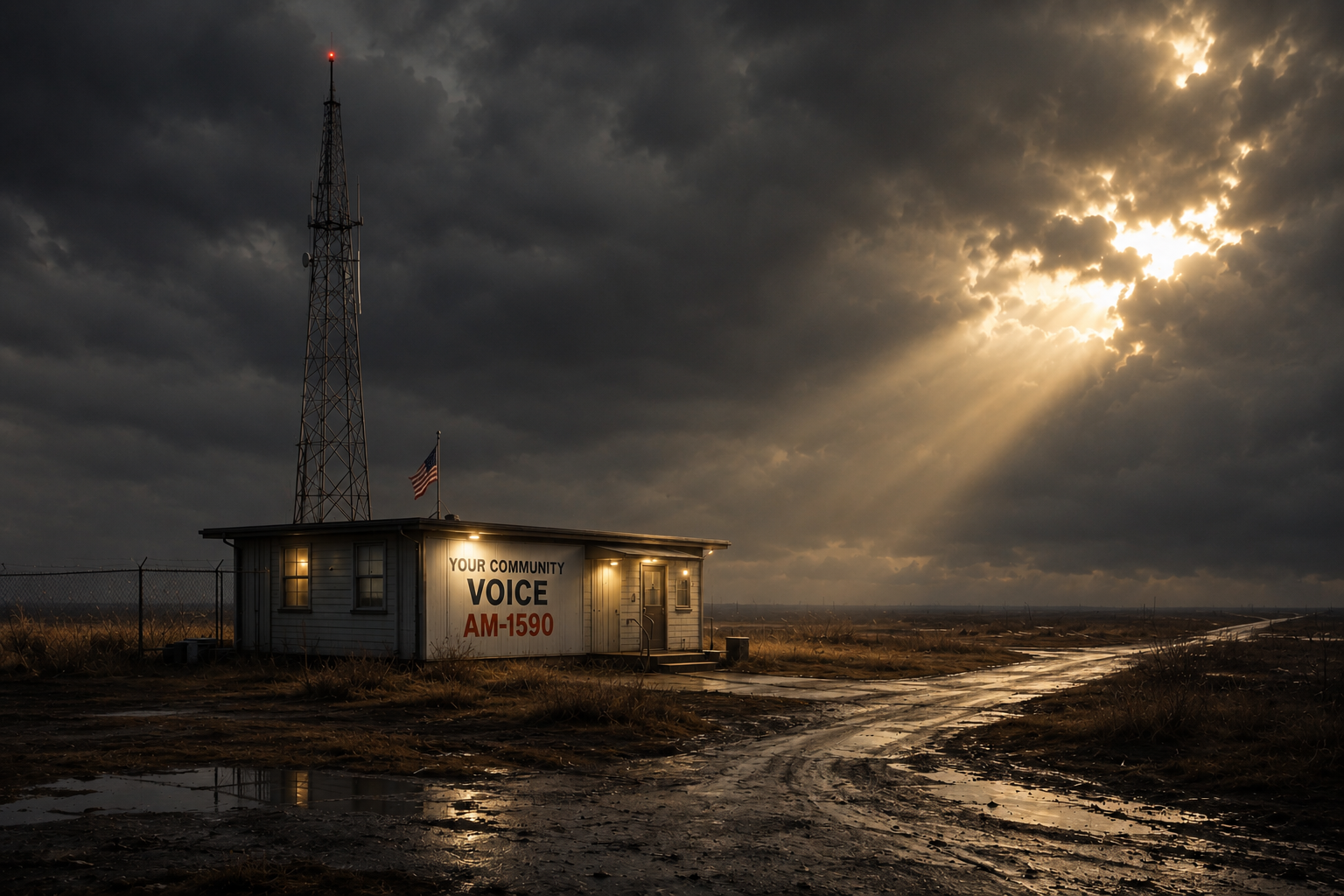
PUBLIC DOMAIN IMAGE
What I think will likely happen.
Anything that involves changing international treaties is almost certainly a non-starter. The diplomatic hurdles and getting every concerned party to agree on a single policy are a “moon shot” that could take many years to finalize. During that time, political leadership changes, priorities change, alliances change, and technologies change. Renegotiating treaties is not impossible, but wow, the bar is breathtakingly high.
Another plausible scenario is the USA is left with powerhouse stations in large cities while the smaller outlets get choked out. The economies of scale apply to radio, too. One big signal is more efficient than several small ones. At the other end, small markets may not support a local station, but a strong station from a distant large city can fill in the gap with no extra expense.
After many, many hours of deep reading and research, I believe in the short term (within ten years), the FCC will unofficially allow a hybrid version of the European path. They will not outright force a shutdown of AM radio as some European countries did, but the FCC will let the band lay fallow as stations organically end operations. As badly as I want to see some kind of community radio fill the space, realistically that’s unlikely to happen.
Passively letting AM die is effortless and has the least political and regulatory friction. A few commercial broadcasters will always remain. I highly doubt they will ever drop to zero, at least not in my lifetime. And the FCC, I hope in my lifetime, creates a non-profit community AM broadcast license class.
Ghosts from the halcyon days of commercial AM radio are like electromagnetic waves that no one can see or touch; they mean nothing unless they are received and understood. I don’t want to see over a hundred years of rich history forgotten and a legacy become lost. Let someone else plant seeds in that fallow ground and make it bountiful again.
*CORRECTION /UPDATE: 08/10/2026:
A reader contacted me and suggested that KPEN AM-840 in Kenai, Alaska is “newer” than KKXA, as originally stated. It turns out this is true, with a caveat: Although FCC records show KPEN as active, I cannot verify whether it is still in operation.
The article has been updated to reflect KPEN’s status as “newest” AM radio station. Once again, if anyone has other information please send it along.
I have a recollection in the movie “Oh Brother Where Art Thou” of the Soggy Bottom Boys and “Man of Constant Sorrow” on WEZY. Also of travelling on the road in the ’80s in the Midwest and the only reception, depending on where I was, was WLS and the replay of old time radio shows.
One time a good friend and AM station manager in Omaha explained to me that the Sandhills of NE (and the like) were terrible for distance even on the lower frequencies because of the soils – or lack of anything but sand.
When I was a kid my family would vacation in Wisconsin at a place that was about 7-8 hours away from our home in Illinois. The radio would fade out every ten or fifteen miles and dad would have to tune elsewhere because all the little podunk AM stations along our route weren’t good for much more than that. It seems everyone who grew up from the 1950s-1980s has a story like that. Thanks for sharing.
The same thing should be done on the AM band as was done on the TV band.
Create new radio receivers that function in DRM an all the other current digital formats and let existing stations adopt those formats.
DRM can provide two audio channels in FM fidelity and a data channel, and as well as reducing the transmitter power consumption by 50%.
I still really enjoy AM DXing, something I have been doing since high school (I am 67 now). This is especially true now, given the almost-dead short wave bands. I also wish that more AM stations still provided a lot of local content instead of nationally-syndicated shows. Another disappointment was when I experienced a power outage during a recent hurricane. I was expecting AM radio to be my source of information during the storm but found almost none of the stations even covering it, and I can receive a LOT of AM stations where I live. I found more FM stations reporting than AM stations. I was shocked.
Hi Frank, I got my start in radio by shortwave listening. Like AM, there isn’t much out there anymore. It’s unfortunate there is no little local news coverage now. All these stations gutted their staff and replaced them with syndicated programming, and they still aren’t making money! It does not help that most people get their news and weather off their phones. Hardly anyone thinks of turning on a radio to be informed.
Hi Bill, your idea would solve the static and interference issues, but it would still require convincing people to tune in. That means unique and compelling programming. So there are really two problems to solve: the technical, and the creative. Neither works without the other. Having an AM version of community radio as I wish for in my article would satisfy the creative side. Each station could be its own unique voice without concern about profitability. Maybe someday….
As a retired broadcaster, I am well aware that AM radio is important in emergencies and disasters — but some stations are more important than others.
The 50KW Class A stations matter very much because of their great range (especially after dark),; these stations are generally in (or serving) large cities with concentrated populations, but surrounded by suburbs and exurbs that can easily double or triple the served populations. They also serve as links between regions, allowing people outside the served area learn about disaster relief operations. I live in Tennessee, but I listened faithfully to WWL/New Orleans for weeks following Hurricane Katrina. More recently, I followed WLAC/Nashville after my small town in West Tennessee (nearly 200 miles away) suffered severe tornado damage.
For smaller cities and their surrounding areas, AM broadcasters of 5KW and above serve a similar purpose. In even smaller towns, some AM broadcasters running between 250W and 1KW *may* be the only communication lifeline to the served public.
All of this depends on various factors including whether the station operates at full power 24/7.
In particular, many older AM stations still use older vacuum-tube technology as either primary or backup transmitters. Unlike newer solid state equipment, this older technology is highly resistant to EMP. The major downside is that most of these stations can also “go dark” during disasters unless they have their own backup generators.
FM broadcasters have their place too, of course, and the most powerful FMs with longer range are invaluable in emergencies; but their signals are essentially line-of-sight 24/7, limiting their reach beyond the local areas served. While I have heard powerful FMs over 200 miles away on rare occasions, I would never count on on hearing getting information from an FM station in Nashville or Little Rock from my home near Memphis; in such a situation I would immediately try the local stations that are still on the air, whether AM or FM, and then search for more distant, powerful AM stations.
Yes, we need *some* AM broadcast stations — those that serve large regional populations and poorly serve less populated areas, and which also are “hardened” to continue operation when the power goes out or an EMP burst knocks out solid state broadcast equipment. I would propose that the FCC launch an investigation into which stations are considered essential and provide economic incentives to upgrade (in some cases, downgrade) their physical plants to ensure disaster-mode operation. An important step in keeping these stations disaster-ready must also be staffing; any station that runs automation or syndicated programming as opposed to live/local operation should not qualify for any federal incentives.
Walter, KZ4CR
Hi Walter, thanks for your detailed comment. As I mention in my article, I agree with you that we’ll likely reach a point where there is a handful of powerful stations serving large metro areas while the little guys just get squeezed out.
As for tube transmitters, don’t count on any station maintaining a tube transmitter on a “just in case” basis. And even if they did, who would be out there listening if all the solid state receivers got fried in an EMP event?
To your point though, I believe a robust radio network with coast-to-coast coverage is worth having as a mass media source when nothing else works. But then you get into not just equipment, but also staffing and ongoing maintenance. That’s a lot of money for what is essentially a “spare tire”. I think it would be more practical to find an everyday use for these frequencies and repurpose them for emergencies as needed. At least that way they aren’t sitting around dormant 99.999% of the time.
About tube transmitters: AM stations maintaining tube transmitters probably fall into two groups. The first is the large, well-financed station with older equipment and a full-time engineering staff, where an old tube transmitter is still kept available — think KFI, WABC, etc). The second is the small-market station where getting rid of the old transmitter simply never happened; I used to work a few of these, where the old beasts either were kept in shape or could be put back into operation if the local situation made it worthwhile (a FEMA grant, perhaps). Granted the second category of station may be rare since sometimes they’re sold for scrap.
As for who would still be able to listen, the percentage of people would be small, but perhaps not so small as you might think. Old tube radios often wind up in attics, basements or thrift stores, and some are actually collectible. Assuming the power grid can be restored quickly or supplemented with a backup source (batteries from a no-longer-operating solar power station, for example), those radios could be lifesavers. Persosnally, I keep some Amateur Radio equipment in a Faraday Can — a metal garbage can lined with nonconductive cardboard — for such an occasion, and could easily toss in my old CCRadio.
An EMP attack is very nearly a worst-case scenario, while natural disasters are the more common situation for needing powerful AM stations with big coverage areas. In many parts of the country, the primary EANS station is already an AM station, and these should be FEMA’s first concern when it comes to keeping EANS operational.