As common as air.
Handheld transceivers, or HT, is ubiquitous in amateur radio. For many hams, it’s their first radio. For others, they may operate only one “main” base or mobile radio but have several handhelds. And for some hams, perhaps a lot of them, it’s the only radio they own. If you are in this latter category and think just a handheld radio will serve all your needs, I’ve got a reality check for you. Handheld transceivers
From horse & buggy to rocket ships.
My first handheld radio was an Icom 2AT. For those of a younger vintage who may not know, in the 1980s the 2AT was a hugely popular 2 meter HT with an analog thumbwheel tuner and 2.5 watts of transmit from a small NiCd battery. It would only do standard 600 kHz repeater splits. If your repeater required a PL tone you were out of luck because the 2AT didn’t have one unless you were brave enough to crack it open and install an aftermarket PL board (which was programmed by clumsy DIP switches). And, it was dense and brick-like. A 2AT cost $200 in 1983, which is about $650 in 2026 dollars.
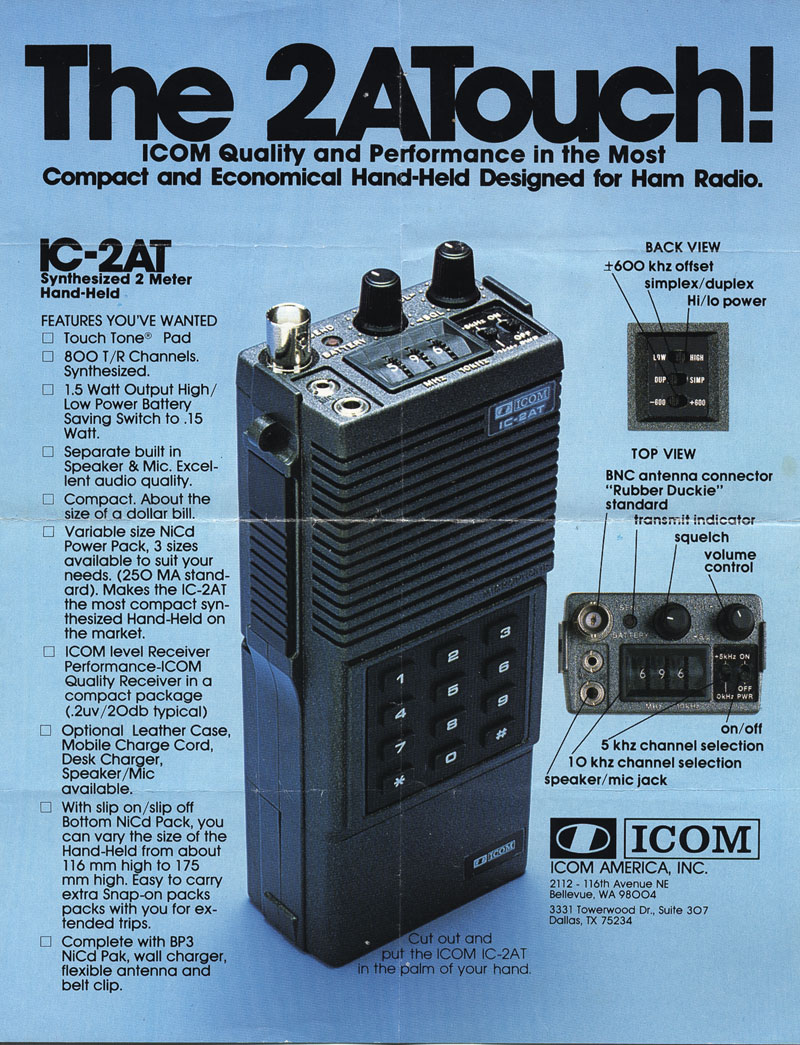 PUBLIC DOMAIN PHOTO
Can you imagine, in 2026, paying $650 for such a primitive radio? Thanks to advancements in technology, no one has to. Modern HT’s are smaller, lighter, fully programmable, multi-band, multi-mode, dual VFOs, TFT color displays, lithium batteries, customizable any way you please. They offer ten times the features for a fraction of the price. If you are from the era when the (by modern standards) rudimentary 2AT was king, people who whine and talk trash about cheap handhelds from Asia should truly amuse you. Handheld transceivers
A Lamborghini with Walmart tires.
All of the modern radios available today have the same “Achilles’ heel” that no amount of research or advances have been able to resolve: low transmit power and poor antennas.
If you buy a new handheld radio today, you’ll get the same few watts output and rubber antenna as handhelds had four-plus decades ago. Due to the laws of physics, there isn’t much room for improving antennas. And due to space and weight limitations, output power is not going to increase unless there is a Nobel Prize-worthy breakthrough in battery and transmitter components. To put it another way, science has given us the radio equivalent of a Lamborghini, but we’re forced to buy the tires from Walmart.
A generational curse.
The problem of low power and seriously underperforming antennas are why a handheld radio will always be a compromise and should not be your primary form of communication.
Having a highly sensitive, well filtered receiver in the palm of your hand is not the benefit it seems if it’s connected to an inferior short rubber antenna. Likewise, the transmit range is limited by both the antenna and the battery.
A two or three watt radio with a small non-resonant antenna is not going to throw a signal more than a mile or so, perhaps less, when you’re communicating with another handheld. You will pick up range if the other station has a better/higher antenna or the conditions are optimal, but in general handheld radios are effective only for short distances. My handheld can only sporadically hit a repeater less than five miles away, and the repeater antenna is around 150 feet. Handheld transceivers
This problem is and always has been inherent to handheld radios. No amount of advanced microprocessors, miniaturization, or full feature firmware will cancel out the disadvantages of small batteries and crappy rubber antennas.
The false faith of handheld transceivers.
A lot of radio amateurs are placing way too much faith in their handhelds, especially as it relates to emergency/disaster communications. An amateur once confidently declared that in a disaster he can easily access a nearby repeater. This level of denial is breathtaking. Assuming the repeater survives the initial incident and still has power, in emergency situations functional repeaters will be buzzing with traffic. Does anyone want to compete for time on a busy repeater? And what is the plan when the repeater backup power runs out?
As we’ve covered many times before on this blog, it’s imperative that you field test your equipment before you truly need it. In the case of handheld radios, this means making sure you can hit important repeaters and identify any “dead spots” in your area. Never assume a repeater will be available to help you. Test your handhelds in simplex mode with any other equipment you have. The performance may be much better (or worse) than expected. It’s important to know what you can do ahead of time.
If needed, higher powered radios and better antennas for VHF/UHF are relatively inexpensive. Of course you will not have the portability of a handheld, but that’s a tradeoff you will have to accept.
You’re probably not in the 1%.
This circles us back to a basic maxim: There is no one single radio that does everything, or even most things. If you’re overly dependent on handheld radios, I hope the previous analysis persuades you to reconsider your plan.
Being able to maintain effective local communications without the aid of a repeater or any grid-dependant resources should be a bare minimum ability of anyone who wants to be prepared for emergencies. If you’re somehow able to do that with just a handheld radio, then I guess you can disregard this entire article. But for the other 99% of operators, apply some realistic thinking to the limitations of your handheld radio, and patch the holes accordingly.
Love the Icom 2AT! I’m very fortunate that here in the Houston Texas area, I can hit 10 repeaters from my home. I’ve also replaced all my antennas with a higher quality one than the one that came in the box. I do need to start calling on simplex to check to see what’s what. Thanks for the reminder! I enjoy the posts!!
Hi Mark, there are some “tuned” rubber HT antennas that are vastly better than the stock antennas that come with handhelds. However, they are still a compromise. You are wise to test everything before you really need it.
And yeah, it seems every ham who was active in the 1980s has a IC-2AT story to tell. What a legend!
I’ll be a bit blunt here. I was CRO for the local ARES group for a while right before I quit in disgust with the whole fiasco. I often found myself wondering how some of these guys ever passed the licensing test in the first place. I was running 75W into a repeater antenna mounted 150+ feet up the county’s primary communications tower. They’re running a handheld putting out 4 or 5 watts into a 6 inch long antenna, and they couldn’t figure out why they could hear me and I couldn’t hear them? I won’t even get into how “interesting” it was when we were working for a big bicycle race and we lost access to the primary repeater and had to switch to a backup repeater and simplex operations with a couple of guys acting as relay on some parts of the course. We had actual plans in place to deal with this kind of thing. The problem was no one had ever bothered to get these guys to actually practice doing it.
Anyway, everything you said is absolutely true. As the old saying goes, “You can’t fool Mother Nature”. Physics is physics.
(sidenote: Come to think of it, why are we even providing communications for things like bike races anyway? They have these new fangled things, cell phones, they call them, where literally everyone has a phone in their pocket. But that’s a topic for an editorial over on the blog one day I think.)
Hi Randy, I always appreciate hearing from my regulars!
The old ham radio saying “if you can hear them, they can hear you” does not apply to FM. And even the most thoughtful, well organized plan is just a nice idea until it is tested in the real world.
When I was a teen ham in the 1980s growing up in Naperville, Illinois, my Icom 2AT with a stock rubber antenna could hit a repeater in Bolingbrook, Illinois about five miles away, but only under prime conditions. The repeater antenna was on a water tower, about 150 feet. Putting a cheap 1/4 wave magnet mount antenna on my parents’ car made all the difference in the world. I could easily make Bolingbrook with full quieting from anywhere in Naperville. When I got my own first vehicle (a truck) I upgraded to a 5/8 wave.
I had several ham friends and we were close enough to work each other on simplex. That was probably fortunate because I doubt the old dudes would appreciate us kids constantly yakking on “their” repeater. We would only use the repeater when we were too far apart for simplex or needed to use the autopatch. Remember autopatches? Yeeeehawwwh we were cool way before cellphones were a thing!
As a strange sidenote, Naperville was then and still is one of the largest and most influential suburbs in the Chicago area, but its never had a significant repeater. Even today, Naperville hams have to use Bolingbrook, Wheaton, Aurora, or Downers Grove, all of which are at least a few miles away. That makes using an HT with a rubber antenna a pretty rough experience. When I’m in town I use an external antenna.
As always it’s great to hear from you, Randy. Thanks for stopping by.
my HT handles my quarter wave entenas well and the 1.5 watts excites my 80 amp just fine.
Hi iron, yes there are “tuned” HT antennas. I’ve used these myself. They do improve performance and are not bad for what they are but are still a compromise.
Adding an amplifier will certainly solve a lot of problems, with the tradeoff of less portability and much higher power requirements.
Thanks for your comment; I hope you’ll stop by again soon.
An HT and an amplifier ‘brick’ are tools for the toolbox, but aren’t a 100% solution, either. The HT receiver can be the weak link in that scenario.
Years ago, I was trying to work simplex over a 225 mile path on 223.5 MHz FM. I was on an 800-foot hill, with a maybe 10 or 12-element Yagi mounted up about ten feet pointed at a 3500-foot mountain top two states away.
I had a Yeasu 220 MHz handheld powered by external DC from my vehicle, and a 15-watt 220 MHz brick. If I turned on the brick’s RX preamp, the resulting boost overloaded the HT’s RX front end filtering with too much off-frequency energy. I heard Country Music from a nearby FM station, courtesy of receiver-produced intermodulation interference. I had to copy the weak 220 MHz signal as best I could using the HT’s RX alone.
But, of course, “it is better to have it and not need it . . . .”
Hi Tom, I’ve found that amplifiers with an HT are a band aid solution, but if that’s what you have then roll with it!
Thanks for stopping by.
Chris,
I’m a new subscriber.
I bought my 2AT used for $200 back in the day. Later, a Mirage amp. Poor man’s Mobile/Base/HT. It was all I could afford back then. Good memories; too bad I couldn’t open any repeaters with PL tone required. Like you said, fast-forward to 2026 and $200 will buy you a LOT more radio. I’m still amazed after 50 years in this hobby.
HTs have their place. I use one, connected to my 35′ roll-up J-Pole, to talk “very local”. I have a 50-watt rig that’ll do the same thing, but sometimes I just need a quick-and-dirty setup that sucks very little power and can even reach the local club’s repeater in a pinch. After a hurricane, it’ll go for days without needing a (solar) recharge, especially while listening (situational awareness).
Our neighborhood CERT uses 5w (they put out about 3w) GMRS HTs (GM-30, I think) and cover our 1/2 x 1/2 mile mobile home “village” nicely on simplex. Perfect for our use case. As weekly NCS for our little GMRS Net, I hook up that same dual-band ham-tuned roll-up J-Poll or a mag-mounted vertical on a cookie sheet on top of my metal shed-shack roof at about 10′ AGL and run the 10-minute net with full quieting signals both ways. Specific application, and it works just fine. But, you’re so right, I don’t want to be “that guy” who tries checking into my local ARES net with 50% signal/50% noise and wonder “why?” nobody hears me. I guess the point is: match the radio (power, antenna) to the job at hand.
One of my favorite things to do: hook that 35′ J-Pole to my Clearnode, connect to an Allstar node (controlled by iPhone app), then jump on the golf cart and ride around listening to a net from my 10 mW Clearnode broadcasting via a “height is might” antenna. Golf Cart mobile is one of my favorite ways to operate in the neighborhood.
Enjoying your stuff. Glad I found you!
73, Paul
N4FTD
rota-radio.com
Hi Paul, I had the external microphone, 12v car adapter, a few extra batteries, a drop
In charger, and a “tuned” rubber antenna. As you well know back in those days there was no Amazon or cheap knockoffs. Everything was OEM accessories with OEM prices. I think I spent more on the extras than I did on the radio! I was a high school student; what little money I had went into radio gear.
“I guess the point is: match the radio [system] (power, antenna) to the job at hand.”
This is called ‘balancing.’
Back in the 1970s, the common two meter mobile radio around here was the Regency HR-2B. Six crystal-controlled channels, no PL, 10 watts transmit and 0.50 uV sensitivity for 20 dB quieting.
A repeater was considered ‘balanced’ if that Regency radio could be heard anywhere that its RX could copy traffic on the repeater. Repeaters with too much TX power were called “alligators,” i.e. “all mouth and no ears.” The rare repeater with not enough TX power might be called a “jack rabbit” for its ‘ears.’
Then newer, quieter RX front end transistors came out, and Icom introduced the IC-20 mobile with 0.25 uV sensitivity. Half the required signal voltage of the Regency meant one quarter the RX signal POWER was needed. The RX sensitivity was now 6 dB or one ‘S’ unit better. Since the Icoms required 1/4 the RX power, they needed 4x the TX power to work the weaker ‘balanced’ repeaters they could now hear.
Hams said the new Icoms had “40-watt receivers.”