How can you not know?
One would have to be astonishingly out of touch not to know about the tariffs implemented by the United States and the political acrimony surrounding them. But many hams may be surprised to learn that solar tariffs specifically are a more than fourteen year old policy stretching across several presidential administrations.
So are solar panel tariffs really an issue? Is this something hams should care about? Yes and no.
As one might expect with government policies, tariffs, particularly solar tariffs, are remarkably complex. Off Grid Ham is not a political blog, nor am I a trade law attorney. There will be no screeds, praise, blame-casting, or apologetics here. I’m just a radio guy.
The average ham is likely not interested in wonky foreign policy analysis, trade agreements, and labyrinthian commercial import regulations. They just want to know how much solar panels cost and whether prices are likely to change soon. On that matter I think we can find some clarity.
Tariff terminology.
A trade remedy is a legal measure for responding to various trade conditions. It follows an investigation and may or may not result in payment of duties
A tariff is an ordinary tax applied to imported goods according to a published schedule.
A duty is an additional charge applied to imported goods as the result of a trade remedy. It is possible for a duty to be charged in addition to a tariff. It is also possible for a duty to be charged, but not a tariff.
Duty and tariff are often colloquially used as interchangeable terms, but in this context they are not the same thing.
There are two common types of trade remedies: antidumping and countervailing duties (AD/CVD). Antidumping is exactly what it sounds like. A foreign producer or exporter sells or “dumps” products into the United States at less than their normal value. The United States government can impose duties on those products to counteract the effects of the artificially low prices.
Countervailing duties are somewhat similar. A foreign government heavily subsidizes a product or industry to give producers a competitive advantage. The US can in turn impose duties on the affected products to offset the subsidy.
In both cases the purpose of tariffs & duties is, presumably, to protect domestic producers and level the playing field. Of course it sounds real nice in theory, but unintended consequences frequently muck it all up. That’s when politics comes into the picture.
Solar panel tariff background: it’s complicated.
It seems these days the default is to blame President you-know-who for everything, including solar panel tariffs. If we can set aside personal political affinity or disdain for a moment, the objective truth is that solar tariffs have existed in one form or another since at least 2012 and subsequent presidents of both parties have carried forward, modified, and expanded them.
Oh, but it gets better. And more complicated.
Blanket tariffs on an entire class of products are quite rare. In many cases tariffs apply only to raw materials or components of a product. For example, the original 2012 trade action included crystalline silicon photovoltaic cells from China, including those incorporated into finished panels. However, separate duties did not apply to aluminum, copper, or other materials used in those same panels.
In 2014, the United States expanded its trade action. To evade existing duties, some Chinese manufacturers started sourcing solar cells from Taiwan for use in otherwise “made in China” solar panels. As you can guess, that plan did not sit well with the US government and Taiwan ended up on the tariff list too.
In 2022, the Commerce Department began investigating Cambodia, Malaysia, Thailand, and Vietnam for their possible role in helping China evade tariffs by routing solar panels through their respective countries. The administration at the time granted a temporary duty waiver to all four countries while the investigations proceeded. In August 2023 the investigations concluded that some of the manufacturers involved were circumventing duties, and others were not. The 2022 waiver expired in June 2024.
Since 2024, various investigations and trade actions have been ongoing. Tariff qualifications have depended on the type of product, country of origin, and the manufacturer. As recently as November 5, 2026, the International Trade Commission published its final injury determinations regarding solar imports from India, Indonesia, and Laos. The ITC conclusions cleared the path for the Commerce Department to issue the applicable duty orders.
Wright’s Law is back.
Even someone who is only vaguely familiar with solar panel prices knows the costs have not just dropped, they’ve spiraled downward to a point where panels have become the most frictionless part of pricing out a solar power system. Check Amazon or any retailer and it is not hard at all to find solar panels at less than $1.00 USD/watt retail. Out in my backyard right now I have some 135-watt Kyocera panels I purchased in 2014 for about $230 USD each. That comes out to $1.70/watt, a very good deal at the time. That same panel today goes for about $120, nearly half what I paid back in 2014.
There are several forces at work here. First, economies of scale. More efficient use of factories and logistics resources allows manufacturers to increase production without substantially increasing fixed costs, which in turn reduces the per-unit price of the end product.
Wright’s Law, a topic we’ve addressed before in this August 2024 Off Grid Ham article, is on full display in solar panel manufacturing. For the uninitiated, a super-simple explanation of Wright’s Law is that the cost of a product will go down by a predictable percentage every time cumulative production doubles (see also: Swanson’s Law). Cumulative global solar capacity has increased exponentially since the 1970s, and it shows in today’s prices.
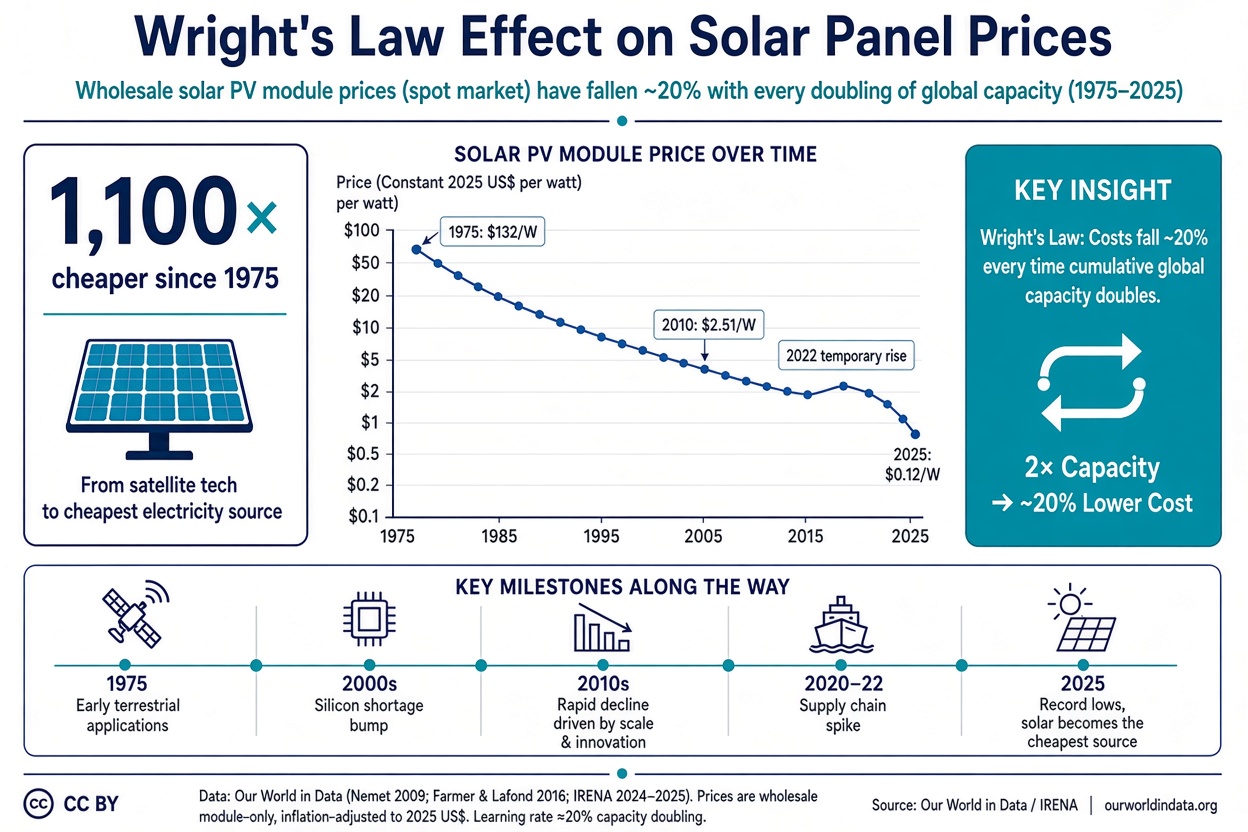
GRAPHIC GENERATED BY AI FOR OFF GRID HAM.
Improvements in manufacturing processes and technology chip away at the costs as well. In the early days, the 1970s and 1980s, solar power was a boutique technology used primarily by spacecraft, research institutions, and very dedicated off-grid homesteaders. Production runs were small; prices through that time ranged from $12 to over $100 per watt. Can you imagine paying hundreds, or even a thousand dollars or more for a ten-watt panel? If there were any hams using solar back then, they were either quite wealthy or running QRP.
Where we are today.
At this time, worldwide solar panel production capacity exceeds near-term demand. In a highly competitive market, manufacturers are heavily incentivized to keep their factories going, even if doing so creates an oversupply. Oversupply is one of many factors that lower prices. Solar power becomes within reach for consumers who previously could not afford it, and those with existing systems are encouraged to expand them. That’s the cycle we’re in now. In general, manufacturers would rather sell more product at a lower price than let factories sit idle, and that’s good for off grid radio amateurs.
Where we should be concerned is that this manufacturing environment is not infinitely sustainable. Panel manufacturers are willing to operate at thin profit margins only as long as the economics justify it. If supply exceeds demand for an extended period, or the profit margins become too small, the factories may reduce output or shut down entirely. That has the potential to push prices back up.
Today the conditions are very favorable for radio amateurs to get into solar power, but it’s a delicate balance. The only way prices stay as crazy-low as they are is if the world keeps buying solar panels. We may well reach a time when the market is saturated and there is little demand for more. I don’t see that happening soon, but it’s not inconceivable.
It’s also important to know that tariffs don’t necessarily mean higher retail prices. Depending on the particular trade action, duties can apply to imported solar cells, finished panels, or both. Finally, manufacturers, importers, and distributors will sometimes absorb all or some of the added cost rather than pass it along to customers and risk alienating them.
What this means to current and prospective off-grid hams.
The tariff talk that’s inciting all the political rancor is a shopworn old issue insofar as off-grid hams are concerned. The United States has imposed various trade restrictions on solar products since 2012. If you bought a new solar panel since then, there is a decent chance you paid some kind of tariff on it. Tariffs have been factored into the retail cost of solar for at least fourteen years.
So why start fussing about it now? Panels today are already the least expensive in their entire history. We’re talking literally pocket change per watt. How much better can we realistically expect it to get? In a world where inflation is a huge pain point for everybody, solar is one of the rare things that is cheaper than it was a decade ago. Do not obsess over timing the market. Do not let the political hyperventilating dissuade you. Look at the bottom line! If you’ve been thinking of jumping off the grid for the first time, or expanding the solar you already have, this is the best age ever to just do it.
I’m glad I don’t use solar panels…