From unknown to everywhere.
My very first HF radio, a Heathkit SB-102 I bought used as a newly-licensed teen ham, had the same problem faced by nearly every radio operator of the era: proprietary power connectors. As I got more absorbed into amateur radio, I collected more equipment and every device had its own exclusive connector. If a cable broke or went missing, I could not simply swap it out or borrow one from elsewhere. Getting a replacement could be expensive or difficult and cause weeks of downtime. This problem was so common it was hardly even thought of as a problem. It was something operators almost unconsciously accepted and endured as the cost of participation. None of us knew it then, but a solution already existed. Anderson Powerpoles, connectors virtually unknown in the ham radio world at the time, would ultimately become the de facto standard.
Edison’s contemporaries.
In 1877, thirty-year-old Thomas Edison already had about 140 patents behind him and was on the cusp of bursting into international acclaim when he introduced the phonograph in December. That same year, two brothers, Albert and J.M. Anderson, founded the Albert & J.M. Anderson Manufacturing Company in Boston, which made electrical products. It started with bespoke machined parts. When electricity adoption took off in the 1880s, Anderson turned its attention to mass-produced switches for industrial applications and electric streetcars. In 1953 Anderson filed a patent for what would eventually become today’s Powerpoles. Ideal Electric bought Anderson in 2001 and ended Anderson’s 124-year run as a stand-alone corporation. The Anderson name and product line still thrive today as a subsidiary of Ideal.
The earliest ancestor of today’s Powerpole is the original 1953 SB connector. Industry was evolving quickly and needed DC power connectors that could satisfy what seems to be an unreasonable list of demands: genderless, solderless, capable of very high current, low resistance, hot-swappable, physically robust for harsh environments and rough handling, easy to install and work with, and cost-effective.
The “British Invasion” music movement. Johnson is President. The Powerpole is born.
The exact pedigree of Powerpoles is not very well documented. We do know Anderson first started using the name in 1965 and was granted a trademark by the U.S. Patent & Trademark Office in 1967. Between then and approximately 2000, the names “Anderson” and “Powerpole” were not in any radio amateur’s vocabulary. Anderson products were used almost exclusively in commercial and industrial applications. In the 1970s and 1980s, another company, Molex, became prominent as a major manufacturer of automotive connectors, and that carried over to ham radio. The term “Molex connector” evolved into a generic name for ham radio power plugs even when referring to other companies’ knockoff versions.
The seeds were planted.
Going into the 1990s Powerpoles were still virtually unknown in the ham universe. But the versatility of the device set it up to be a sleeper hit. Everything that made them excellent for industry also made them an obvious choice for amateur radio. So why wasn’t anyone using them? The answer is unsatisfactory: no one really knows for sure.
One possibility is that, in the 1990s, hams would likely turn to Molex for homemade projects because that was the traditional “go-to” product and any Radio Shack or neighborhood auto parts store sold them. Radio manufacturers in turn just kept doing what they had always been doing. Stasis is hard to break; the “holy grail” of standardization and interoperability was closer than ever, but no one realized it…yet.
The dam breaks.
Around the year 2000, amateur radio EMCOMM operators discovered Powerpoles and began adapting them into their equipment. No one is sure who was first, but the trend seems to have started with ARES groups in California. From there, they made the leap and spread like wildfire.
Suddenly, the problem of everyone using a different connector had a solution. Without any single, central authority decreeing so, Powerpoles became the unofficial standard. Beyond the connector itself, the assembly and orientation became part of the standard. Powerpoles are genderless, so any connector will mate with any other connector. By establishing a common protocol of having the red connector on the right and the tongue up, a lot of cross-polarity errors are eliminated.
The acceptance of Powerpoles became so widespread that most ARES/RACES groups now require them, as well as many government-affiliated response organizations. They’re not doing it to be difficult. They’re doing it to maintain a standard so that anyone can trade a cord with anyone else. That can really matter in emergency situations where coordination down to minutiae such as a power connector can make a meaningful difference in the effectiveness of the organization.
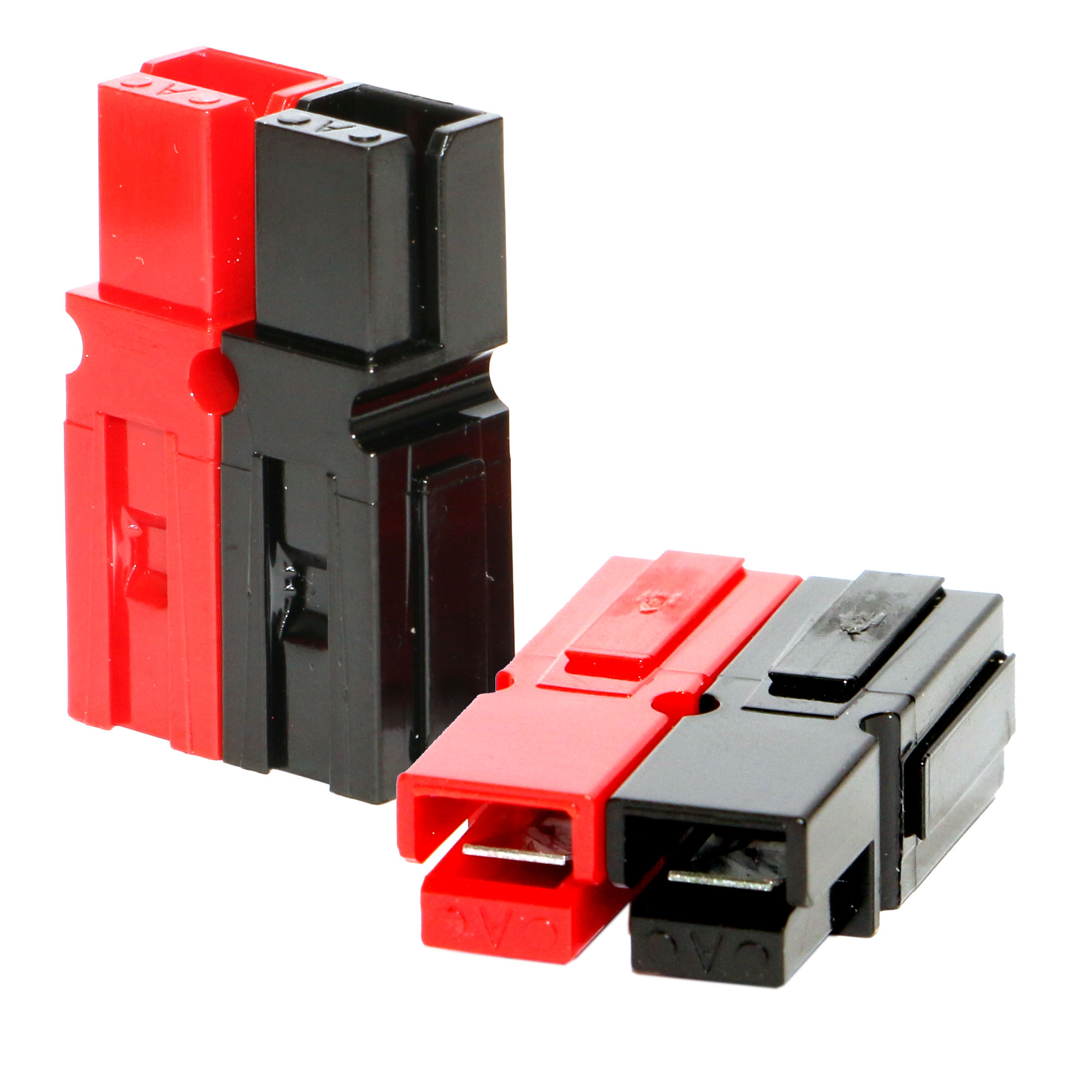
STOCK PHOTO
The manufacturers refuse to join the party.
The huge flaw in this brilliant plan is with the manufacturers themselves. More than two and a half decades into Powerpole adoption by hams, the “Big Three,” Icom, Yaesu, and Kenwood, still use proprietary connectors on all their radios. My research shows only Elecraft and FlexRadio offer factory-installed Powerpoles. The internet is full of instructions on how to convert non-standard radio DC connectors to Powerpoles, but in this day and age no one should have to. Corporate marketing departments enthusiastically talk up amazing technological features built into their radios, and to be fair, the features are amazing, but the power connector on the back is still in 1985. Come on, Big Three! Read the room!
Adoption on the accessory side is much more promising. West Mountain Radio in particular, offers dozens of power management products and every one of them has Powerpoles. That is the beauty of having a standard. You can have four different products from four different manufacturers, and if they all use the same DC connector, your life is so much easier. Stocking separate spare connectors for every piece of equipment you own is awkward and expensive. Plus, it introduces operational inefficiencies that may really matter in times of urgent need.
From obscure industrial part to fan favorite.
Anderson wasn’t thinking about amateur radio when it rolled out the Powerpole, and even today its marketing material doesn’t mention hams. The company produces dozens of types of electrical connectors; its primary customer base always was and still is commercial, industrial, data, and transportation. But surely Anderson must be aware of the impact this single product had on amateur radio.
I cannot think of any other instance where a random, mundane, not-exactly-high-tech item influenced ham radio to the point that it changed the way operators engage with their avocation. No one planned it that way, but the backstory is remarkably simple: Radio amateurs transformed an obscure electrical connector known only to industry professionals and insiders into a ubiquitous and essential component found in ham shacks everywhere.