A generational split.
There’s good chance those under the age of 50 live in a home without a traditional, hard-wired dial up phone. If you’re under the age of 40 you probably never, not once in your life, called through an operator, dialed 411, or used a payphone. Do you even know what 411 is? The decline of “plain old telephone service”, or POTS in industry lingo, matters to radio amateurs in ways they may not realize.
Your grandad’s Bell System.
From its inception, the telephone system in the USA was deliberately set up as a “benevolent monopoly”. It was not technically possible for different companies to run separate wires everywhere. In response, the government gave the respective Bell Operating Companies (BOCs) exclusive right to provide telephone service. At the same time, Western Electric was acquired in 1881 by what would ultimately become AT&T. Western Electric had exclusive right to manufacture and sell all the equipment used in the network. So not only was there a monopoly on telephone service itself, there was also only one company supplying the equipment. AT&T, the BOCs, and Western Electric were collectively known as the Bell System.
As a tradeoff for having a stronghold on every aspect of the market, the Bell System was subject to government regulation and price controls. This foundation was the genesis of the legendary, reliable, rock stable phone service. That reputation lives on to this day. Whether that image is still deserved or not is a different matter. This synergy worked well, more or less, until a 1982 landmark antitrust case busted up the monopoly. The court ruling took effect in 1984.
Amateur radio and POTS lines.
For a long time, ham radio and telephones were complementary services. Hams would orchestrate “phone patches,” interfacing radio with a phone line so those in faraway places without phone service, such as military members, could call home. Phone patches were also important during emergency situations. Likewise, many VHF and UHF repeaters had “auto patches” that allowed hams make phone calls from their radios.
Still today, many hams involved with EMCOMM and disaster preparedness insist that POTS lines are the “gold standard” of reliability, especially during power outages and in areas with poor cell coverage. If you still believe this once-true maxim, I’m here to bust it to pieces.
Many survival/preparedness blogs and internet forums have extolled the virtues of POTS lines, citing the usual tropes of reliability and stability. The problem with this conclusion is that POTS lines are quickly being phased out, and the ones that remain are hanging by a thread.
Ma Bell is in a nursing home.
It’s true that historically the telephone network was incredibly robust. Your dad, grandma, maybe even yourself, may recall having a home phone line for decades and it never once went down.
Today, if you have a dial up line that is still steady and working, you’re just lucky! There are no phone switches less than twenty years old, and most of them are older than that. Spare parts are no longer manufactured; they are cannibalized from decommissioned equipment. The technicians who truly knew how to service phone switches retired years ago. Those who are left have to BS their way through maintenance tickets, sometimes even using Google and YouTube, because their employers never trained anyone behind the retirees. The copper wires POTS lines run on are decades old and no one is interested in spending the money to maintain them.
The court ruling from 1982 would have implications for equipment deployment that still ripple out over four decades later. Western Electric was no longer the exclusive supplier. That was good for innovation and keeping everyone competitive, but it also complicated the front line technicians’ jobs because there was no longer a common standard. Every manufacturer had its own training methods, protocols, procedures, and in some cases specialized tools.
Universal Telephone Service and Carrier of Last Resort.
As one of the regulatory conditions of holding monopoly status, the BOCs were required to provide universal telephone service. This meant providing service, at regulated prices, to pretty much every customer who wanted it. If it meant running a wire miles and miles down a country road to serve a single remote farmer, the phone company had to do it. And they could not charge that farmer any more than everyone else.
Meanwhile, a parallel policy known as “carrier of last resort” (COLR) came into being. What that means is if no provider can or will supply service to a given area or customer, the COLR must do it, even if unprofitably. After that 1984 court ruling when many new phone companies known as competing local exchange carriers (CLECs) popped up, AT&T or one of the state BOCs was usually the COLR. It’s easy to see why the legacy Bells didn’t like this arrangement. Any CLEC could pick and choose, provide service only in densely populated, high profit areas and leave the scraps out in the country to the COLR. It wasn’t exactly a level playing field, but that’s how it worked.
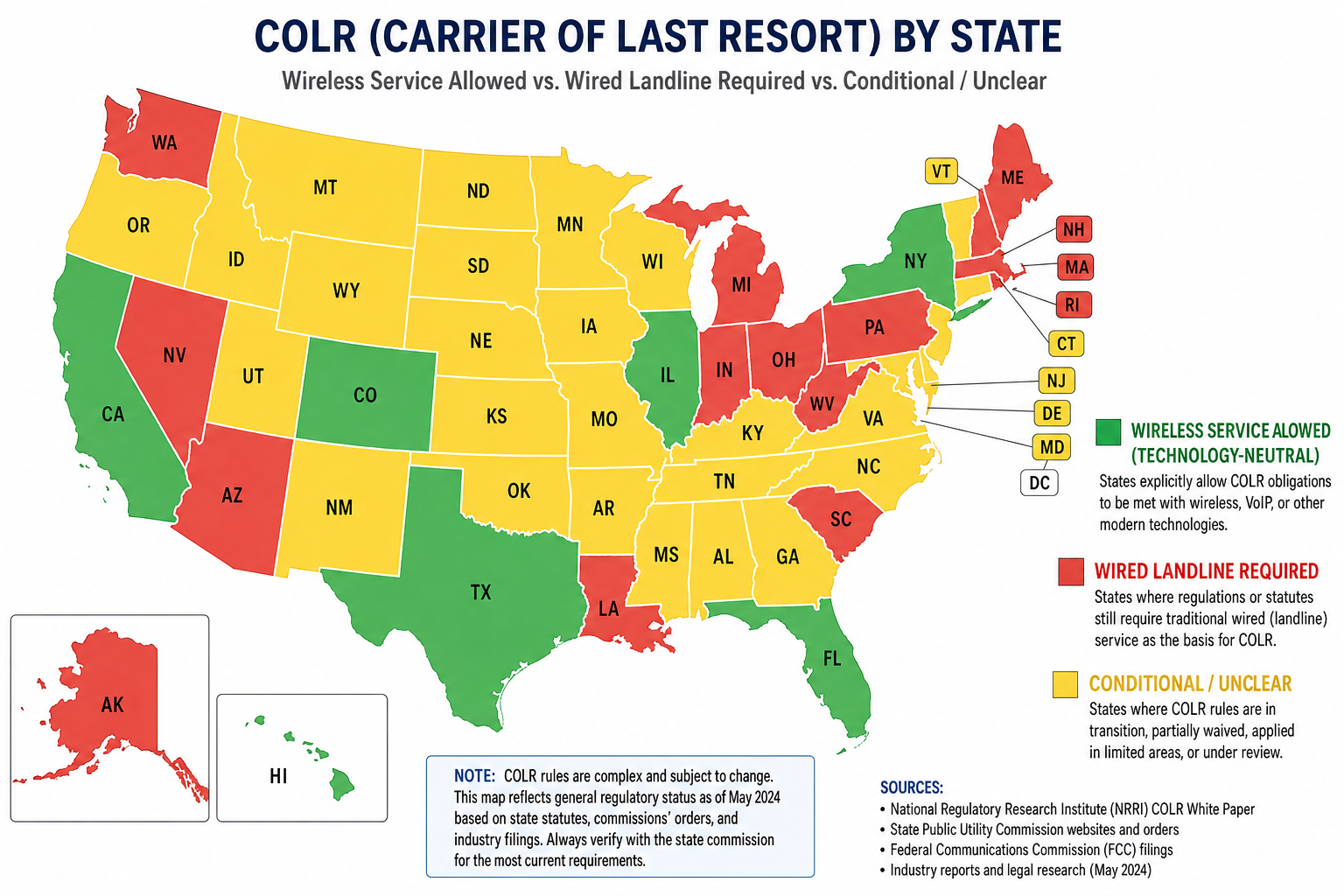
GRAPHIC CREATED BY ARTIFICIAL INTELLIGENCE FOR OFF GRID HAM.
Changes to what COLR is will be the final death of POTS.
For a long while “last resort” meant a wired POTS line. Now, several states have changed that expectation to mean almost anything else.
Only fifteen states explicitly require wired landlines as COLR service to all customers. All the other states either outright allow other services such as wireless or have varying degrees of exceptions. Technically, a cheap cellular flip phone would satisfy universal service and COLR regulations in most states.
At this point COLR rules are the only thing keeping POTS lines alive at all. The decline of traditional dial up phones will accelerate as states widen standards and allow other means of providing service.
The sunset of POTS matters to radio amateurs.
Many public safety agencies are getting rid of their dial up landlines and going with internet based or wireless voice systems. To the radio amateur this may not directly matter, but they will be effected if those systems fail.
Many hams who are deeply involved with survival and preparedness swear by their trusty dial up POTS line as a complement to their radio setups. But as we’ve discussed, that image of rock steady, reliable phone service is largely nostalgia. The cellular network, which is modern and has a much higher priority for restoration during a disaster, is a far better bet.
I urge all ham operators to plan for the day, which is coming soon, when access to a dial up POTS line will not even be a third or fourth choice.
How I know all this.
I am a recent AT&T 35 year retiree. Early on I was in customer service and writing software for ISDN circuits (if you know, you know). But for most of my tenure I was a technician in a central office. The central office is the engine room of the communications system. What was once dial tone and analog pulses is now internet and wireless. I’ve seen the evolution in real time.
I spent much of the last two years of my career ripping out obsolete dial up equipment. Lucent 5ESS, Nortel DMS, EWSD, Fujitsu FLM, Litespan…it’s all old, tired, band-aided together 1990s technology. Also consider copper cables that in some cases are over a half century old. This is what your dial up phone lines are still running on. It’s not getting any younger, and no new deployments are planned. Find alternatives, quick! When the guy who fixed the stuff tells you to get rid of it…listen to him.
I left city life for the extreme rural in 1995. The rural cooperative telephone company was a joy to work with and I guess it kind of helped that the service guy who covered our part of the Nebraska Sandhills became a personal friend. When dial-up internet was being phased out and moving to DSL outside of town my buddy set me up at the top of the list. Woo-hoo! No more darn modem!
Now I live even much further rural and in a dead zone for cell service – or any other utility for that matter. Enter Elon Musk and Starlink. For three years we finally have phone service via data connection and the calls are clear as can be – including high def audio and video if desired. If on a call and it is poor quality or breaking up it’s not on my end. A lot of people don’t like Musk and he can be a bit of a pain. But I sure have some debt of gratitude. So times they are a changing yet again.
Hi JR, I’m glad you found a solid solution. Starlink is going to keep a lot of rural folks connected as Rich now there is no meaningful competition.
I’m a millennial and recently found myself in a position to buy my first home. We’re in a rural county, where cell service is spotty. I’ve considered signing up for a traditional phone line, but I dread being harassed at all hours by telemarketers. Being inaccessible is a luxury these days, until it isn’t.
Hi AS, thanks for stopping by.
I would say get the traditional landline if you can, but start looking for alternatives because it’ll be on life support form Day One.
I retired from Lucent (get my pension checks from Nokia now) in 1990 in Central Office Planning, Rolling Meadows Illinois. This article brings back memories, some good, some bad. Also the split cost many of us to lose money on the various Tel Co stock !
Hi Tom, thanks for your input.
I am somewhat familiar with the Rolling Meadows facility, as well as the one in Naperville.
When I left AT&T a little over a year ago, I took the lump sum and invested it. I’ve got no hard feelings towards AT&T but I don’t want to be in bed with them for the rest of my life!
I’m older than you. I hired on with Pacific Northwest Bell in 1979 and worked in Special Services as a testboard technician the entire time I was there (15 years.) First the Private Line board, then the Telegraph board (sending fox to field repair techs so they could adjust the margins of the old electromechanical teletypewriters), then back to Private Line, then I got moved to the SARTS center. That Lucent and Nortel equipment that you decommisioned was the latest technology in my day, almost everything was still WECO equipment. I remember when the first Nortel equivalent to a T carrier system was installed, between Bell Plaza in Seattle and one of the other COs (because I was voluntold to be the project manager of sorts, scheduling the cutting over of circuits onto the new system. I met a couple of very nice Canadian tech reps, who presented me with a Nortel coffee mug as a thank you for meeting the project deadline so they could go home.
I left because the layoffs had started. It all began with managers wearing those pale yellow, dark spotted “power ties” with light blue shirts, soon followed by Tom Peters books about downsizing and “rightsizing.” Upper management decided that they had to follow the latest fad in business management in order to “remain competitive” (competitive with whom? You’re a regulated monopoly!) I took a voluntary layoff right before the involuntary ones began so I would get a higher severance pay and decided to change careers to computer support, right before the end of the dot com boom and the start of the gig economy. Impeccable timing, right?
POTS was a reliable service because the DC voltage and ground and AC ringing current needed for POTS phones to work was supplied by the central office over the cable pairs. As long as the cables didn’t get damaged it continued to work. It’s just very ancient technology that would be better replaced by community cell phone systems (UHF radio systems) powered by solar or wind energy or by VoIP over fiber-optic lines. The problem is that cell and fiber service including Internet is for-profit in most places, so your lone farmer at the end of a miles-long dirt road still won’t be getting service any time soon.
Anyway, there’s nothing at all inherently wrong with the old technology, it’s just very expensive these days. I remember reading about how rural farms in the midwest had their own telephone service linked by a strand of barbed wire on fences, They supplied their own battery and ground. Sometimes TelCos would give them the equipment and encourage them to set up barbed wire systems so the TelCos wouldn’t have to spend the money to install copper out to the remote farms. These systems were probably noisy, and farmers had to go outside to a fencepost-mounted phone instead of having the instrument in their hose, but it worked. (We used to say, “if it’s touching, it’s talking.”)
73 de DV7GDL
Wow, Dave. Thanks for that great story and relating your experience. I am very familiar with all the Bell lingo you used.
When I was involved with ISDN in the late 90s, it was the hottest product since Touch Tone. All the overtime we could stand. We could not turn them up fast enough. We didn’t know that in less than a decade it would all fizzle out. Luckily I got out during the peak and moved to the central office, where I remained until I retired. All the ISDN people got surplused (ie, laid off) or reassigned to places they didn’t want to go. Had I not left when I did, that would have been my fate too.
I graduated college and was supposed to be a high school English teacher. I took a “temporary” job at Bell. I did not intend on staying more than a year or so. All the old buzzards warned me that the longer you stay, the harder it is to leave. I laughed them off. I stayed 35 years.
Land lines were always working and if something did happen to them they were fixed quickly.
A short time ago I cancelled my service after many decades with the same phone number. The monthly rates kept going up and worst part was the 10 to 20 sales calls I got everyday wanting me to buy a new warranty for something, life insurance or something. I called just about everyone to see if this scam stuff could be stopped and the answer was always no. I stopped answering the phone. The monthly fees still kept going up, I cancelled.
POTS is or was a good idea for emmcom but then if one telephone pole goes down there is no working phone line. There are thousands of poles…
I miss my old phone and the simplicity if calling someone.