The forgotten, invisible servant.
Radio amateurs by nature love “stuff,” especially stuff that looks cool. Lots of knobs and dials. Colorful, dancing displays. Tall towers with imposing antennas. Large solar panel arrays and multi-kilowatt generators. Beyond the bling and all the geeky tech that attracts hams like kids to an ice cream truck, there is an important element that gets little attention. It’s not cool or particularly fun. It’s often forgotten, or at best an afterthought. No matter how awesome your radio is, no matter how tall your tower or how many watts you’re pushing, none of it will function if it’s not backed up by a solid DC power distribution system.
Everything in between.
A DC power distribution system is defined as everything between the power source and the load. It does not have to be complex. But even if it’s just a small battery wired to a radio, there are things anyone can do to make sure it is safe and efficient.
I’ve seen the extremes: professionally installed industrial applications that were safe and orderly, pushing thousands of amps, to slapped-together DIY electrical quackery featuring blobs of wire that look like a bowl of spaghetti. You may have seen some of these guys showing off their freakish engineering on the internet. Our goal is to avoid being “that guy.”
The basic ingredients are, well, basic.
The elements of a DC power distribution system are fairly simple, no matter how large or small the application. For this discussion, we will not get into the power source itself (solar, gas generator, AC power supply, etc.) or auxiliary components such as inverters. We will only cover the actual infrastructure needed to get the DC power from the source to the radio.
So where does that leave us? A proper DC power distribution system typically has these elements:
- A battery or AC-DC power supply. In most cases a station will have both.
- If a station does have both, there needs to be a way to switch between them.
- Wire of appropriate size and type to connect the components.
- Blocks, buses, and splitters as needed to distribute power to more than one device.
- Fuses and breakers for safety.
- Manually operated switches as needed.
- Nylon ties, cable clamps, Velcro straps, and similar items for cable management.
- A solid, dedicated surface to mount the components.
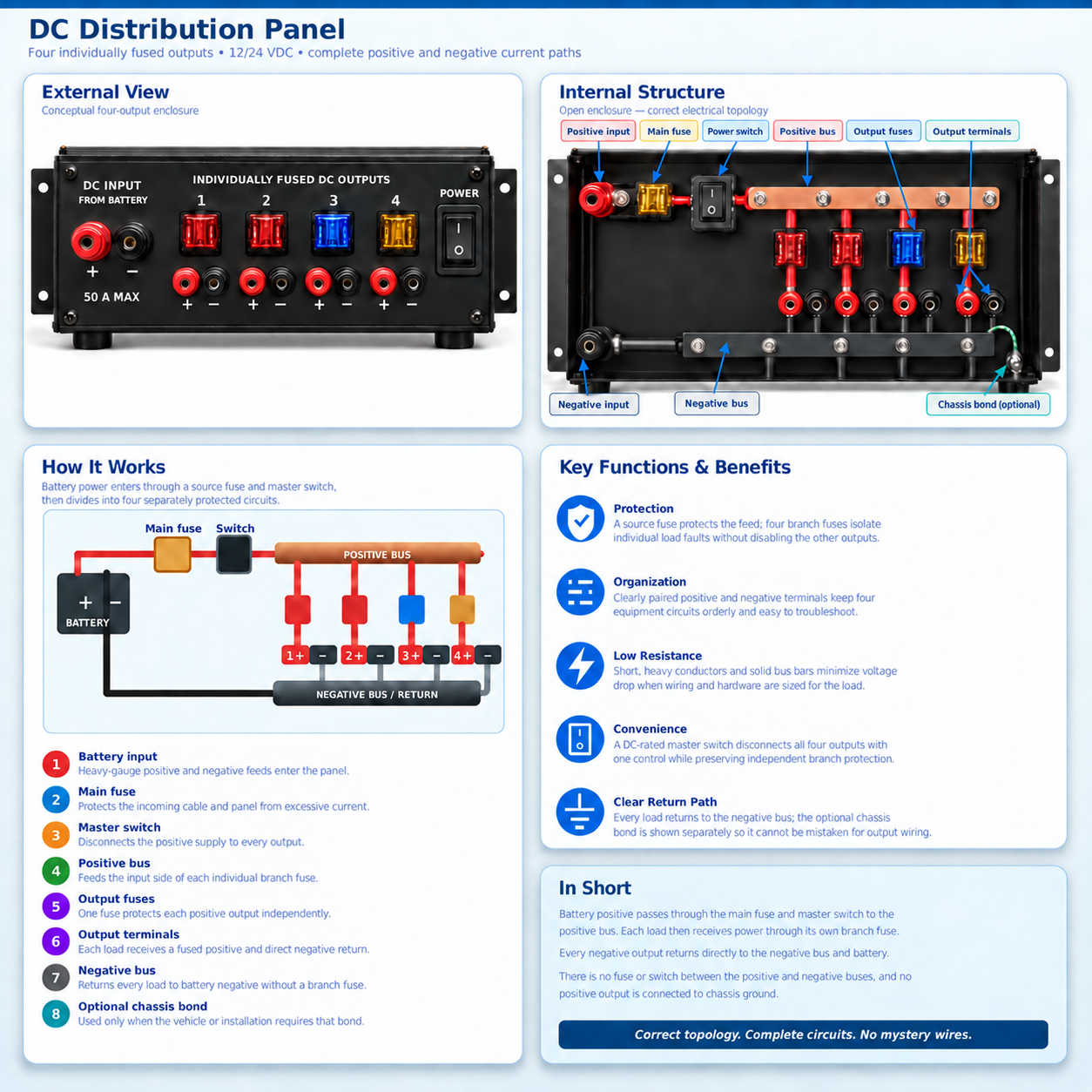
GRAPHIC CREATED BY ARTIFICIAL INTELLIGENCE FOR OFF GRID HAM.
A word about wire.
The wire in your DC power distribution system is probably going to be the weakest link. Unfortunately, DC is very “lossy” and will drop a lot of voltage even in short runs if the wire is not properly sized.
Example: You have a roll of 12 gauge/3.31 mm² copper solar panel wire. Your panels produce 15 amps at 15 volts and your wire run will be 30 feet/9.1 meters. You might not think the wire size or length really matters. In fact, you’re going to lose about 9.5% of your voltage. That “15 volts” out of the panel will be 13.57 volts at the other end of the wire. A general expectation is to keep losses at 3% or less; this example is more than three times that expectation. The 12 gauge wire is too small. To get within 3%, you would need 6 gauge/13.3 mm² wire. Stranded and solid wire of the same gauge/size, with some nuanced exceptions, have the same current capacity. Most hams prefer stranded wire because it is more flexible and easier to work with.
Here is an on line voltage drop calculator you can use to calculate proper size wire.
What to do about voltage loss.
Using 6 gauge or larger wire to prevent voltage loss is a difficult proposition. It’s expensive, harder to source, and more difficult to handle. Assuming increasing the wire size is not desirable, there are some things a ham can do to minimize losses:
- Reduce the length of the wire run.
- Increase the voltage.
- Add a microinverter to your solar.
Reducing the length might be possible if it does not excessively alter the overall plan. Increasing the voltage is only an option if you have the means to convert it back to 12 volts for your radio gear at some point down the line. This will add additional complexity and expense.
A microinverter is an inverter that is located on or very near the solar panel. The advantage is that the inverter bucks the voltage up and changes it to AC. Higher voltage means less current for the same wattage. This translates into much less voltage drop over the wire run. By the way, this is exactly how power companies send electricity hundreds of miles with little loss, but that’s a separate discussion.
The loss would be almost negligible when transmitting that power at a higher AC voltage in a comparatively small amateur radio application. Also, because the current is lower, you can use smaller gauge wire. The biggest disadvantage is that later in the system you’ll have to change that high voltage AC back to 12 volt DC.
Admittedly, none of these options are very good. For some, they may be a practical if not essential choice. Most hams, including me, will just accept the loss. No one likes inefficiency, but there is a tipping point where the diminishing returns from squeezing out every last watt becomes an obsession over technical minutiae. Decide where that reasonable point is for your personal situation, and don’t wander past it.
Sending power to where you need it.
The final step in this process is to distribute power to your radio gear. Safety first, though. Place properly sized fuses as physically close to the power source as possible on both the positive and negative wires. Having a fuse on just the equipment is not enough. If there is a short anywhere before that fuse, it will in effect be removed from the circuit and not protect anything.
If you are powering more than one device, you’ll need some kind of bus or distribution panel. The primary power source connects to the panel. You can then plug numerous devices into the panel. Commercially made distribution blocks have fuses for each branch. These do not substitute for having a fuse near the power source itself as we just covered. The branch fuses will blow at a lower current; if you overload one circuit, you will not lose power to everything.
Since DC power distribution blocks are simple, you could make your own as a homebrew project. Honestly, since commercially made units are so inexpensive, making a DIY version isn’t worthwhile unless you already have most of the materials and just feel like tinkering.
West Mountain Radio is a very popular supplier of DC power management equipment. Before MFJ unfortunately closed operations, they had some great DC power stuff too. You can certainly find MFJ products on the used market.
Pulling it all together.
When constructing your power system, neatness counts! Run the wires in straight lines and form right angles for turns. Avoid random angles. Cut each wire to size; do not leave excessive slack. Generously use nylon ties, cable clamps, or Velcro straps to keep wires under control. The distribution block, switches, fuse blocks, and other hardware should be firmly mounted on a stable surface. Do not leave components flopping loose.
Anderson Powerpole™ connectors are ubiquitous in modern radio accessories. Of course, you’re not required to use them on homebrew projects, but Powerpoles have become a de facto standard. It’s almost impossible to get away from them in the amateur radio universe. I recommend keeping Powerpoles in stock and learning how to work with them because you’re certainly going to run into them even if you don’t use them yourself. Numerous retailers sell inexpensive Powerpole connector kits and the proper crimp tool.
Be aware that Anderson is the original Powerpole patent holder and manufacturer; there are many aftermarket knockoffs and outright counterfeits. The build quality, engineering standards, and fit can vary considerably. As always, perform due diligence and know what you are buying.
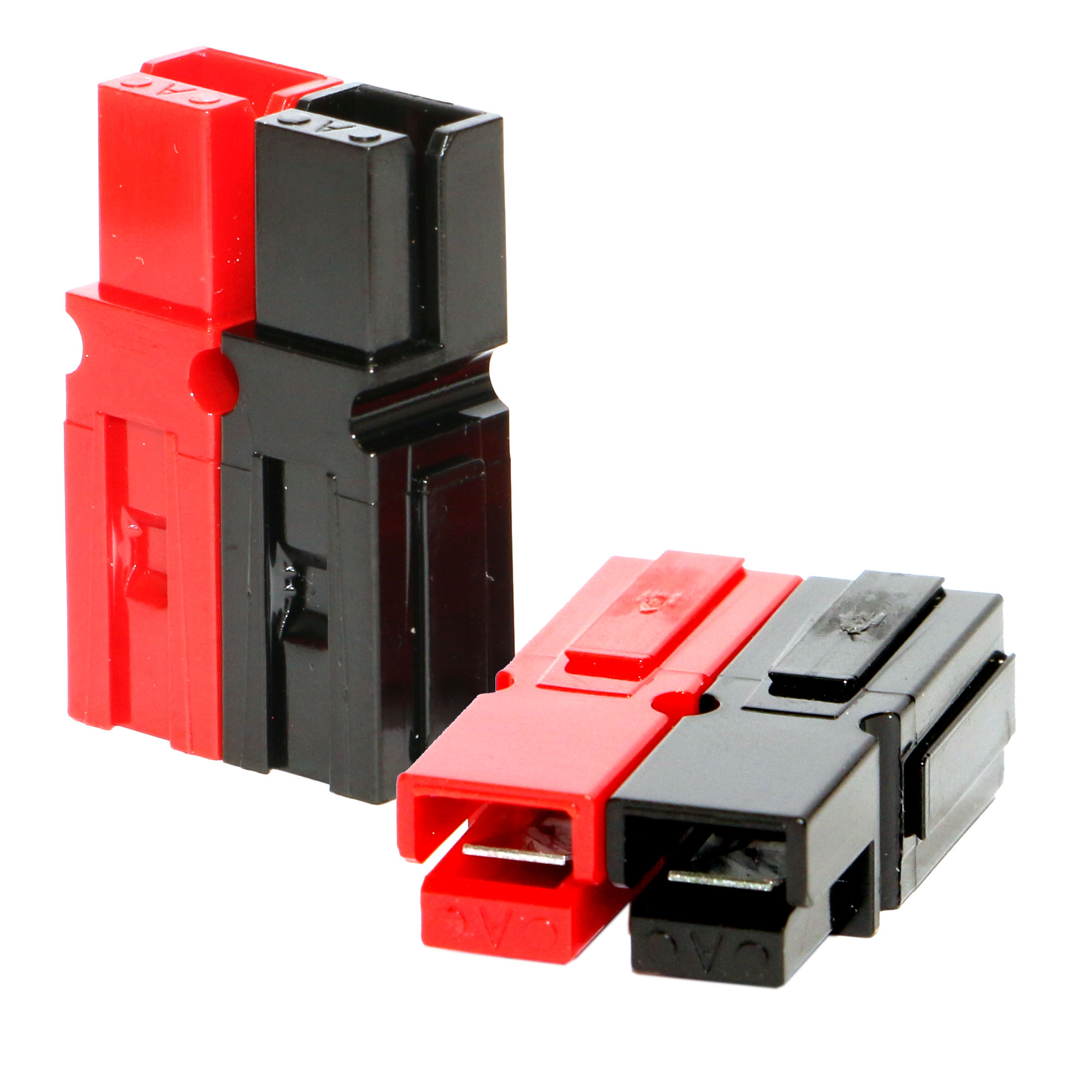
ANDERSON POWERPOLES. STOCK PHOTO
The finished product.
When done correctly, a DC power distribution system is effective, safe, and will not embarrass you if others see it. This often overlooked part of an amateur radio station is just as important as antennas or radios or anything else, and deserves attention. A neglected and poorly made system is at best inefficient and hard to manage; at worst an ugly safety hazard. A little effort now will deliver useful and reliable power to your radio equipment well into the future.