We’re all in the same sea, but not the same boat.
I think it’s safe to assume everyone who reads this blog has some sort of off grid power capability. It might be an elaborate photovoltaic system, wind installation, a gas generator, or maybe just a battery operated handheld radio. Many operators wisely plan for commercial power loss, but few account for the failure of their own backup system.
This article explores off grid power redundancy, testing, and planning for realistic scenarios. It also discusses how behavioral factors and present day decision making strongly influence future off grid power success —or failure.
The psychology of present bias.
If you have ever delayed or given yourself excuses for not getting your backup power systems in order, you may be experiencing what psychologists call present bias.
In simple terms, present bias is the natural tendency to prefer immediate gratification over putting in effort now for a benefit that comes later. Maybe all the stuff you need to set up your backup power is already on your Amazon wish list. All you have to do is click “buy” and everything will arrive in a day or two. Or maybe you did order the supplies and they’ve been sitting in a box in the garage for months because every weekend you find something more enjoyable that provides immediate gratification.
Constructing a backup power system does not have that immediate gratification. You wire it all up, hopefully test it, then it gets set aside until needed. And it may not be needed for a very long time. The reward is postponed.
It’s way more fun to spend your free time chasing DX than messing with equipment for which there is no imminent need. Here’s the problem: when the lights go out, the future need becomes a right now need. Overcoming that hesitation may not be rewarding in the moment. But when the power fails and you’re ready for it, the delayed gratification will be greater than the past effort. You’ll be glad you spent that one afternoon long ago assembling your system instead of rag chewing on 40 meters.
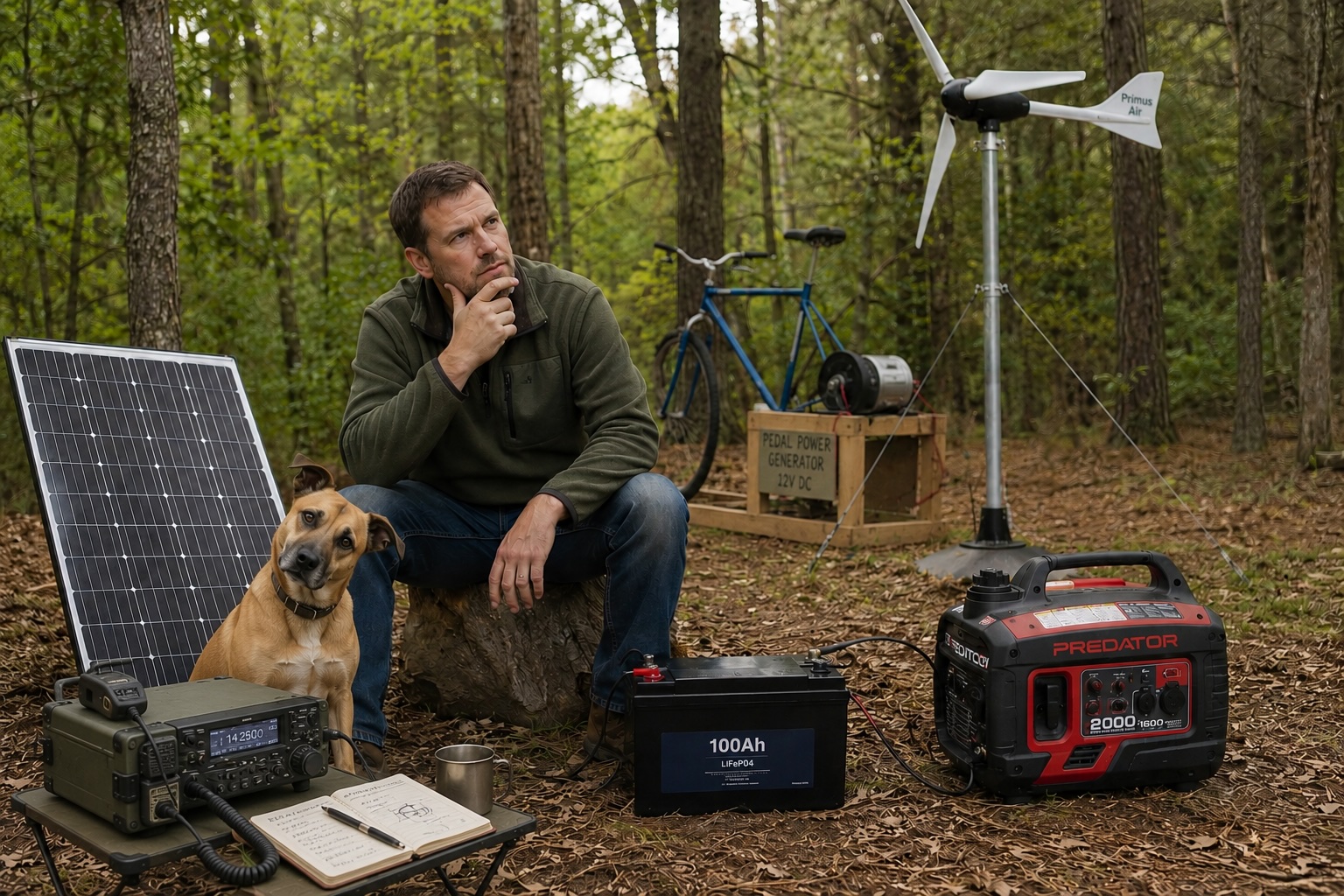
IMAGE CREATED BY ARTIFICIAL INTELLIGENCE FOR OFF GRID HAM.
You’ve heard this advice before.
Many operators consider their off grid capabilities a backup to commercial power. That presumption is accurate, but any off grid system is prone to failure too. Essentially, you need a backup for your backup.
This requires planning. Yes, regular readers well know it’s a recurring theme on this website. The best time to prepare for future problems is when you are not immediately pressured to face them. Being proactive allows deficiencies to be identified and corrected when they’re not a time-critical matter. Being reactive means addressing problems as they happen with no forethought. What off grid resources do you already have? What would happen if those resources failed?
You have to stop somewhere.
If redundancy is a priority, where does one stop? Obviously, no one can have infinite “just in case” backups. At some point we need to decide what is enough. For me, that point is my main solar power. Beyond that I have two homebuilt solar options: a 100 watt semi-portable unit and a 27 watt setup with a ten amp-hour lithium battery. The latter is assigned to a go bag QRP radio but is adaptable to other applications. Lastly, I have a 7000 watt gas generator, and a few battery powered handheld radios. To support my systems I keep a substantial stock of fuses, connectors, wire, and parts.
If anyone in your group has a useful technical skill, ensure they have the tools and supplies needed to be effective. If no one with advanced technical training is available, the average radio amateur can —and should— develop enough basic troubleshooting abilities to manage his or her equipment.
What does a backup to a backup look like?
Your secondary backup will (or should) be individually crafted to your living situation, energy needs, budget, and technical abilities. For some of you it may be as simple as an extra handheld battery and car charger. Luckily, having additional, independent energy capability does not have to be expensive.
Ideally, the “backup to your backup” should be a different type or fuel source than your primary backup. If your main backup is solar, you may want to choose a gas generator. This gives you diversity and avoids problems that can’t be eliminated simply by changing to a different system of the same type. For example, if your solar power production is low because of a cloudy day, switching to another photovoltaic system is not going to help.
If for some reason you do decide to have two or more systems of the same type, have spare parts and supplies needed for repairs. You may not have control over a failed solar controller or a generator breakdown, but you can keep common spare parts available.
Don’t go overboard.
On the other end of the scale from those who have no backup are those who prepare for unlikely doomsday scenarios while overlooking obvious and real problems right in front of them. Folks who are prepared for Armageddon but ignore the smoke alarm that’s been chirping a low battery alert for the last week may want to reevaluate their priorities.
As we already mentioned, no one can realistically be ready for every conceivable failure. Rationally address the most likely situations; only after that plan for dystopia. After all, the odds of major societal collapse are low, but they’re not zero.
Implementing your backup to the backup.
Any system —primary, secondary, or otherwise— should never sit dormant for extended periods. Periodically place the backup power system under an electrical load and operate it in the real-world application for which it was intended. This accomplishes a few objectives:
First, it exposes operational or design deficiencies. Examples include difficult setup methods, missing parts, cords that are too short, incompatible connectors, or design or process flaws that adversely affect operation.
Second, it will reveal any previously unknown malfunctions or breakdowns. Examples include blown fuses, frayed or broken engine pull starters, loose, dirty, or broken connections, dead batteries, engine oil, fuel, or coolant leaks.
Third, it will keep skills sharp; anyone who might use the system should be included in these drills.
The goal is to ensure both systems and people are ready when needed. No one wants power restoration delays due to fumbling around under pressure over a problem that could —and should— have been resolved ahead of time.
When an investment has nothing to do with money.
Whether one’s priorities are immediate benefit or preparedness for improbable scenarios, the common theme is misaligned priorities. On one side, the psychological need for immediate gratification overrides the wisdom of investing effort now for a benefit later. On the other, there is such a narrow attention on unlikely disaster scenarios that more relevant “real world” problems are overlooked. The solution lies in the middle. Like any investment, a modest sacrifice now will yield significant benefits later.
“Essentially, you need a backup for your backup.”
Interesting article. Written for folks that mostly have a grid connection but if it fails:
We’ve been off grid since 2010. Not even a cell signal. I have a 11kW Miller Bobcat welder in the shop that throws 240 to a stepdown in the house. I can’t afford to run that 3600 rpm thing except for an emergency. Our main genset is a 5kw max 4kW continuous and it has an easy life. But it’s a short life. I’ve been through 3 of them under warranty after the original purchase. What a PITB. And silly stuff that I can’t get parts because it is not serviceable.
I’m finishing up with a 6/8kw single cylinder diesel that will be our primary. Pop, pop, pop at low RPM. No more road tax fuel in the State that uses the revenues for everything but roads. Being a diesel I can load it and it doesn’t even flinch and not sound difference. 20,000 hours to a refresh with std maintenance. Pop, pop, pop. This my solution to consumer stuff be it Honda or Harbor Freight. Those are not really commercial grade which you want if you are off grid and it is essential.
It’s a moving target. Until you put the right equipment in place. And don’t keep adding loads. Definitely not too big but enough to handle any surge loads. So it’s prime spot is 70-80% of normal running load. I’m a bit under that % but the unit never runs less that ~ 24 aac.
I’m a bit anal about this having spent more on generators and repairs that I want to admit and I’m an electo-mechanical guy, machinist and mechanic of stuff from toys to locomotives. But if you are truly off grid you have to have the machine that works like a Caterpillar or equivalent. But they don’t have small diesel generators. But you want one that works like a Cat or runs like a Deere. Finding a small low RPM diesel is difficult.
I didn’t mention fuel savings?
Hi JR, I’m always glad to hear from you. I especially appreciate your perspective as full time and long time off-gridder.
This isn’t just about those on commercial power. No matter what you have, you need at least two of them. It looks like you have that covered very well.
And you are absolutely right about generators. The cheap 3600 RPM “screamers” are fine for an occasional storm or weekend power failure, but no one would want one for an extended period. Even if you could afford the fuel, the engine will blow itself to pieces in, I would say, about 500 hours. I’ve seen “contractor grade” screamers that at least have an oil filter on them. They would likely run well past 500 hours but there is still the noise and fuel issues. A Honda inverter generator will go much longer and use less fuel. It’s probably the best bet for a small gas generator.
The “holy grail” of generators are 1800 RPM diesels. I’m not sure such an animal even exists under 10 kW and they are quite expensive, which places them out of reach for the average ham.