Expand your band.
One of the habits many off grid hams fall into is they operate in a silo, meaning, they hang out only on the ham bands, often the same one or two bands, and barely know what’s going on beyond that. It’s not by default a bad habit. If you are into ham radio solely for hobby/recreational purposes and are happy with what you’re doing, then don’t change anything. Enjoy it in your own way and don’t concern yourself with what others think is important. But if your involvement in ham radio is motivated by emergency preparedness, prepping, survivalism, or similar pursuits, even superficially, then it’s important to know what’s going on in your radio neighborhood writ large.
Good news and bad news.
Unfortunately, many of the most desirable non-ham communications are on encrypted systems and cannot be heard on any equipment available to civilians. That’s the bad news. The good news is there are still many active frequencies for government agencies and private entities anyone can receive on commonly available radios. True, monitoring is not as fruitful as it used to be, but there is still a lot of useful communications out there, so don’t leave anything on the table. your radio neighborhood
Radio bands you should be paying attention to.
The CB radio band 26.965-27.405 mHz: In the USA, CB has devolved into a “junk band” full of illegal operators and general nonsense. However, in some locales it is used for legitimate purposes. So, CB may or may not be a “must have” depending on where you are. For decades, CB was AM or SSB, but FM was approved for use in 2021.
Public safety bands: “Public safety” is a broad term that can mean many things. The most common users are police, fire, and medical, but non-government organizations such as the Red Cross use the band too. Within these frequencies you’ll also find services such as water and electric crews, snow plows, and road maintenance.
- 30-50 mHz
- 150-174 mHz
- 450-470 mHz
- 769-775 mHz
- 806-824 mHz
- 851-869 mHz
Specifically, 154.280, 154.295, and 154.370 are popular. 155.475 mHz was once widely used as an state or region wide emergency channel and may still be active in your area.
The 450-470 UHF band is more specific to local areas. 460.100, 460.400, and 460.900 are common law enforcement channels. your radio neighborhood
The 700 & 800 mHz bands are heavily used in large cities and densely populated areas. Most of it is in digital format which will require a compatible receiver.
Monitoring transportation can yield very useful information. Air traffic control is not that meaningful, but airport ground operations, fire, and security are. Railroads are in the 160.00-161.00 mHz range and are (mostly) analog for now, but are slowly being migrated to Next Generation Digital Narrowband (NXDN).
GMRS, FRC, MURS.
The General Mobile Radio Service (GMRS) is in the 462 mHz band, with some frequencies at 467 mHz. The Family Radio Service (FRS) is 22 channels contained within GMRS. The only difference between the two is GMRS requires licensing and FRS does not. Also, FRS is very restrictive regarding transmitter power, antennas, and other technical parameters whereas GMRS is much more generous. The Multi Use Radio Service (MURS) is in the 151 & 154 mHz bands. It also does not require a license but like FRS there are power and antenna restrictions.
Any of these services are available to everyday citizens for their personal and professional use. You’ll hear everything from campers and hikers to construction crews to covert activity. These services really are a buffet of possibilities. Activity in your area may range from a nothingburger to very valuable intelligence.
Digital systems.
More and more agencies are moving away from traditional analog radio systems to digital. In some cases, they are getting away from “radio” altogether and using cellphone networks.
But do not be discouraged. Many digital systems, such as the P25 protocol, can be decoded with the appropriate equipment.
How much of the important comms in your area are digital? Is it enough to justify the cost of a compatible receiver? If most of what you care about is still on analog networks, then you can get away with an inexpensive analog receiver.
You don’t have to dig far to find gold.
Thanks to the internet, frequency data is no further than your keyboard. The FCC database is publicly available to anyone. It will tell you anything you need to know, but it won’t be easy. As one might expect with the government, the FCC website is clumsy and hard to navigate.
radioreference.com is the oldest and most well run privately operated database. It’s impossible to overstate how valuable this resource is. It’s easy to navigate and provides more information than the average ham will ever have time to digest.
In just a few clicks you’ll get a list of radio licensees in your county and the frequencies assigned to them. The only thing Radio Reference does not track is individual radio amateurs and commercial broadcasters. Radio Reference is free but the advanced features require a subscription. At this time subscriptions are only $30/year.
I urge Off Grid Ham readers to familiarize themselves with Radio Reference and bookmark it. There is nothing else like it anywhere on the internet.
Putting your ears on. your radio neighborhood
As we mentioned, many communications are encrypted and cannot be intercepted by any equipment available to civilians. However, that doesn’t mean there’s nothing to hear out there. Many public safety agencies use digital communications. Luckily, digital and encrypted are not the same thing.
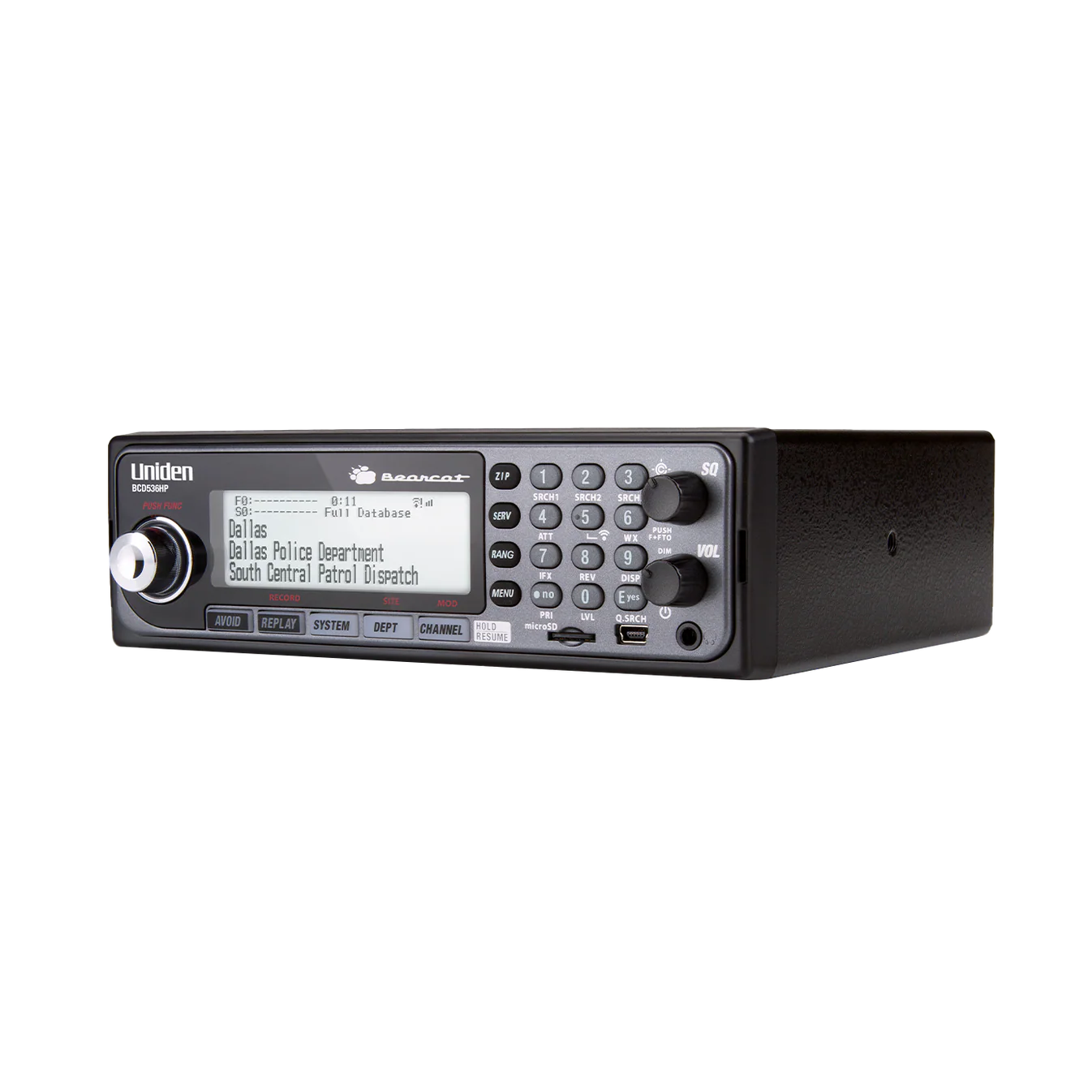
Uniden BCD536HP. STOCK PHOTO.
For example, the Uniden BCD536HP comes in base and handheld versions. It will decode NXDN, P25, and Starcom21, three protocols popular with government and public safety agencies. Scanners capable of decoding digital are not cheap. Expect to pay over $500 USD. Keep in mind that we are in the sunset of analog utility radio. An analog scanner may suit your needs today but at some point, probably less than a decade, you’ll need to upgrade.
Expand your band, the epilogue.
Situational awareness is knowing at all times what is going on around you and forecasting what your behavior will be if the current environment changes. In order to be aware, you need information. For those of you concerned with preparedness, emergency response, or being situationally aware, monitoring frequencies in your radio neighborhood, aside from of your personal communication preferences, is vital to having that information.
Resources.
Here is the FCC licensee database. Comprehensive, but labyrinthian like only the government can.
Radio Reference. Brilliant. Easy to navigate, well organized, encyclopedic in its depth. You absolutely must bookmark this one.
The Scanner School YouTube channel. An outstanding YouTube channel with nearly 600 videos explaining everything you need to know about radio monitoring. This channel is a treasure you’ll want to come back to again and again.
Hey, one last thing before you go….
Did you know that nearly all the topics covered by Off Grid Ham, including this one, are the result of reader comments and feedback? Yes, we take requests! If there is a concept you’d like to see OGH address, drop a comment below or send me a message on the contact page.
Thanks for this write up, Chris. I will be saving this post.
Yesterday on the way to town I pulled over when I saw a guy walking through a particular place. He was a local and it was a recent purchase. After the ‘country style’ introductions which many folks would consider snoopy and invasive he immediately asked me if I had short wave equipment in use. I said I’ve considered it but haven’t jumped in yet. And that we use MURS around our land and the band(s) have no other users so it is relatively private. He literally about got aggressive about my not having short wave eqmt.
His focus was on our risk in this area for aggressive wildfires – every year. He has carved a niche for himself as a relay from short wave to phone communications for the hotshot and VFD crews and updates back to the public. In our area of the PNW, many people are either fully off grid (because many are well past the last mile) or completely able to instantly supply for their needs if the power goes out. Most people have no cell service due to terrain and the population is too low for providers to add towers. We are fully off grid but can stay in contact due to Starlink. We are quite indebted to that evil Musk guy – like him or not.
Anyway, he has me reconsidering adding SW comms to our regimen. Or at least finally adding a good digital scanner which is more likely. I have had a scanner on the shopping ‘want list’ for years….
Thanks again for posting this article.
Hi JR, shortwave for survival/SHTF situations is a mixed bag. It’s designed for long distance (DX). Do you really need that? If your neighborhood is burning, will you really care about talking to another continent? I’m not trying to talk anyone into or out of it. I just want others to have good reasons for their communications choices. Some weird little random backcountry dude ranting about it is, in my mind, not a good enough reason.
FRS? I’m going to be a bit of a curmudgeon here but you’d be better off just shouting at people. They’re strictly line of sight, and the quality of the equipment i’ve seen is little better than children’s walkie talkies. GMRS is a bit better, but not much. As for CB, I sold off all of my CB equipment a long, long time ago. It had turned into a wasteland of whistlers, screamers, foul language and abusive behavior. Anyone trying to use it for any kind of actual real communications was quickly drowned out. I don’t know if things have gotten any better, but I doubt it.
Scanners are fine, or were. Depends on where you’re located. They’d be useless here because literally everything around here is encrypted. There are some businesses I could pick up, some local government maintenance workers, the railroad and occasionally some aircraft, but that’s it.
I’d think you’d be better off investing the money in a good SDR. An SDR with decent software and a good antenna system can pick up everything. And they can be picked up fairly cheap.
I have a Malahit DSP2. a stand alone SDR that’s fantastic. It covers everything from 10 kHz up to 2 GHz (with cell phone frequencies blocked). Waterfall display, touch screen, CW decoder that sort of works. Amazing piece of equipment. Drawback is that it’s on the pricey side, about $500 US. And you need to watch out where you buy it. There are apparently a lot of counterfeits out there.
Hi Randy. Any service that is unlicensed (or loosely licensed) and open to the public is going to attract bottom feeders. That’s just the reality of it. It doesn’t take anything away from the value of the service itself. A lot of the equipment is junky and cheap. That too, does not make the service itself worth less. Many people use GMRS, FRS, etc., and have great success.
As for scanners, you are correct that a lot of it has to do with where you live. In my state, most public safety agencies use P25 encoding. And like my article describes, that’s not the same as encryption. These protocols can be heard with consumer equipment, although it’s expensive. I think ultimately everything will be either truly encrypted or moved to the cellular network, which will make monitoring impossible. Until then, we’ll just have to work with what we’ve got and make the best of it.