As common as air.
Handheld transceivers, or HT, is ubiquitous in amateur radio. For many hams, it’s their first radio. For others, they may operate only one “main” base or mobile radio but have several handhelds. And for some hams, perhaps a lot of them, it’s the only radio they own. If you are in this latter category and think just a handheld radio will serve all your needs, I’ve got a reality check for you. Handheld transceivers
From horse & buggy to rocket ships.
My first handheld radio was an Icom 2AT. For those of a younger vintage who may not know, in the 1980s the 2AT was a hugely popular 2 meter HT with an analog thumbwheel tuner and 2.5 watts of transmit from a small NiCd battery. It would only do standard 600 kHz repeater splits. If your repeater required a PL tone you were out of luck because the 2AT didn’t have one unless you were brave enough to crack it open and install an aftermarket PL board (which was programmed by clumsy DIP switches). And, it was dense and brick-like. A 2AT cost $200 in 1983, which is about $650 in 2026 dollars.
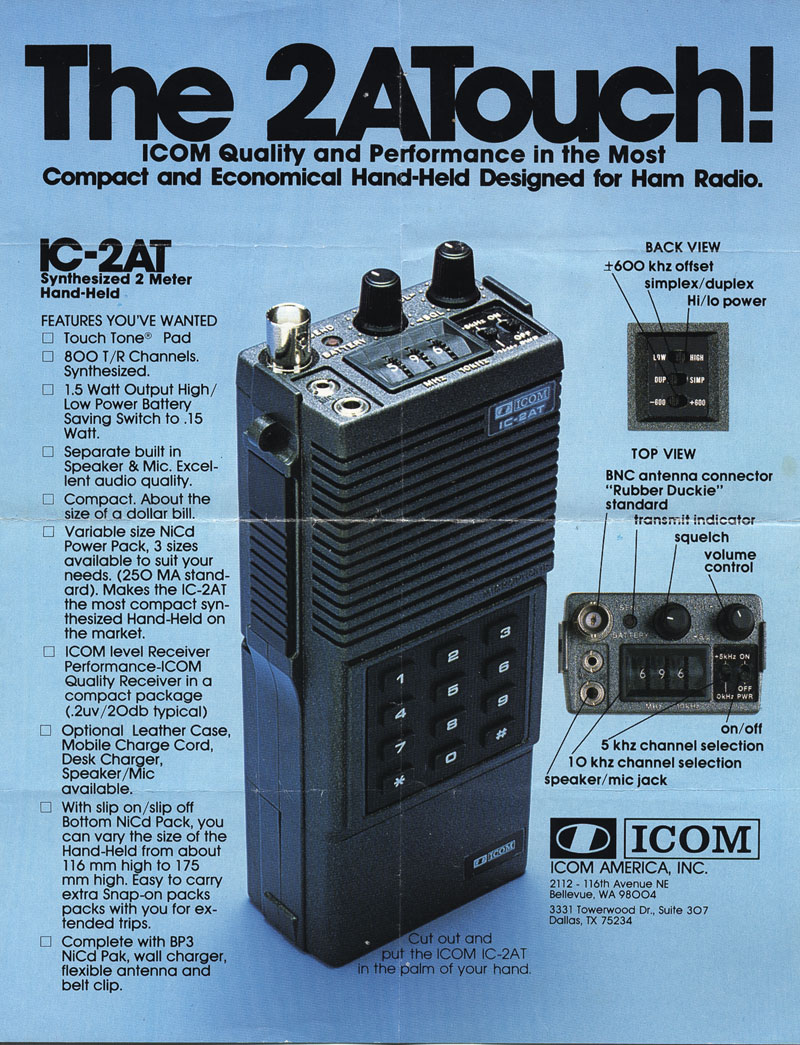 PUBLIC DOMAIN PHOTO
Can you imagine, in 2026, paying $650 for such a primitive radio? Thanks to advancements in technology, no one has to. Modern HT’s are smaller, lighter, fully programmable, multi-band, multi-mode, dual VFOs, TFT color displays, lithium batteries, customizable any way you please. They offer ten times the features for a fraction of the price. If you are from the era when the (by modern standards) rudimentary 2AT was king, people who whine and talk trash about cheap handhelds from Asia should truly amuse you. Handheld transceivers
A Lamborghini with Walmart tires.
All of the modern radios available today have the same “Achilles’ heel” that no amount of research or advances have been able to resolve: low transmit power and poor antennas.
If you buy a new handheld radio today, you’ll get the same few watts output and rubber antenna as handhelds had four-plus decades ago. Due to the laws of physics, there isn’t much room for improving antennas. And due to space and weight limitations, output power is not going to increase unless there is a Nobel Prize-worthy breakthrough in battery and transmitter components. To put it another way, science has given us the radio equivalent of a Lamborghini, but we’re forced to buy the tires from Walmart.
A generational curse.
The problem of low power and seriously underperforming antennas are why a handheld radio will always be a compromise and should not be your primary form of communication.
Having a highly sensitive, well filtered receiver in the palm of your hand is not the benefit it seems if it’s connected to an inferior short rubber antenna. Likewise, the transmit range is limited by both the antenna and the battery.
A two or three watt radio with a small non-resonant antenna is not going to throw a signal more than a mile or so, perhaps less, when you’re communicating with another handheld. You will pick up range if the other station has a better/higher antenna or the conditions are optimal, but in general handheld radios are effective only for short distances. My handheld can only sporadically hit a repeater less than five miles away, and the repeater antenna is around 150 feet. Handheld transceivers
This problem is and always has been inherent to handheld radios. No amount of advanced microprocessors, miniaturization, or full feature firmware will cancel out the disadvantages of small batteries and crappy rubber antennas.
The false faith of handheld transceivers.
A lot of radio amateurs are placing way too much faith in their handhelds, especially as it relates to emergency/disaster communications. An amateur once confidently declared that in a disaster he can easily access a nearby repeater. This level of denial is breathtaking. Assuming the repeater survives the initial incident and still has power, in emergency situations functional repeaters will be buzzing with traffic. Does anyone want to compete for time on a busy repeater? And what is the plan when the repeater backup power runs out?
As we’ve covered many times before on this blog, it’s imperative that you field test your equipment before you truly need it. In the case of handheld radios, this means making sure you can hit important repeaters and identify any “dead spots” in your area. Never assume a repeater will be available to help you. Test your handhelds in simplex mode with any other equipment you have. The performance may be much better (or worse) than expected. It’s important to know what you can do ahead of time.
If needed, higher powered radios and better antennas for VHF/UHF are relatively inexpensive. Of course you will not have the portability of a handheld, but that’s a tradeoff you will have to accept.
You’re probably not in the 1%.
This circles us back to a basic maxim: There is no one single radio that does everything, or even most things. If you’re overly dependent on handheld radios, I hope the previous analysis persuades you to reconsider your plan.
Being able to maintain effective local communications without the aid of a repeater or any grid-dependant resources should be a bare minimum ability of anyone who wants to be prepared for emergencies. If you’re somehow able to do that with just a handheld radio, then I guess you can disregard this entire article. But for the other 99% of operators, apply some realistic thinking to the limitations of your handheld radio, and patch the holes accordingly.